
43.2 Million Illegal Cigarettes Destroyed, Surabaya City Government Targets 31 Districts
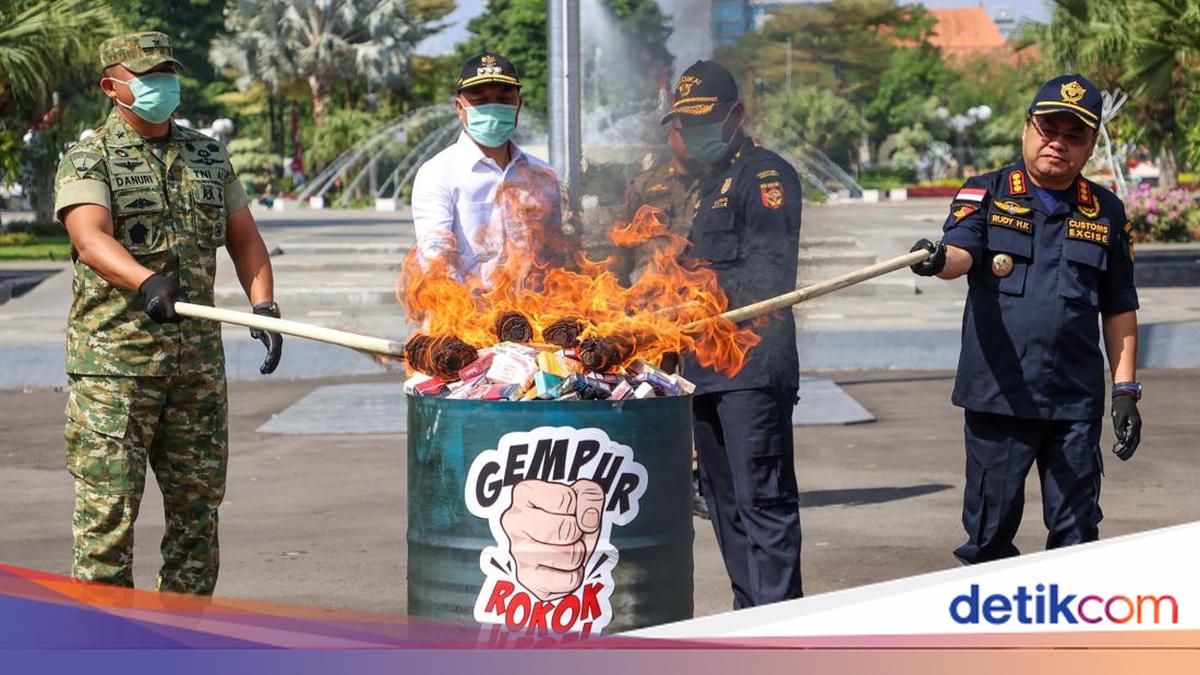
The Surabaya City Government is strengthening efforts to eradicate the circulation of illegal cigarettes by expanding surveillance down to the sub-district level. Previously conducted through a joint task force, monitoring will be developed into area-based supervision across 31 sub-districts.
Mayor of Surabaya Eri Cahyadi said the measure is intended to broaden the reach of illegal cigarette eradication while protecting the public from the impact of consuming tobacco products of unknown composition. “With this destruction, we are protecting the residents of Surabaya. Because if residents of Surabaya smoke illegal cigarettes, they cannot know what substances are contained in the cigarettes,” he said in a written statement on Thursday (27/8/2026).
According to him, eradicating illegal cigarettes is not only related to state revenue but also concerns the protection of public health. He reminded the public of the importance of understanding the tobacco products they consume. “So what we will do with cigarettes, we must be able to know the contents contained in these cigarettes,” he said.
Besides the health aspect, Eri also highlighted the benefits of the tobacco excise revenue-sharing fund (DBHCHT), which is used to support various public needs, including worker protection. “The excise revenue-sharing fund that the government obtains from cigarettes is used for BPJS Ketenagakerjaan. We also use it for matters related to cigarette workers,” he explained.
The strengthened surveillance was carried out simultaneously with the destruction of 43,248,147 illegal cigarettes worth approximately Rp64.2 billion on Wednesday (26/8). The symbolic destruction took place in the courtyard of Surabaya City Hall, while all evidence was destroyed at the waste management facility of PT PRIA in Mojokerto Regency.
Head of the East Java I Regional Customs Office, Rusman Hadi, said that if the illegal cigarettes had circulated, the potential state loss could have reached around Rp36.038 billion. “The destruction activity we carried out involved 43.248 million illegal cigarettes with a goods value of approximately Rp64.2 billion. And the potential state loss if these goods had circulated is around Rp36.038 billion,” he said.
He explained that cigarette tax is a regional tax collected together with excise duty. The revenue is then distributed to the provincial government and passed on to district or city governments. “Thus, illegal cigarettes not only cut state revenue in the excise sector but also directly reduce regional original income that should be used for development and public services in Surabaya and East Java,” he explained.
Head of the Sidoarjo Customs and Excise Office, Rudy Hery Kurniawan, said the destruction was the result of enforcement actions in the first semester of 2026 that had obtained permission from the Directorate General of State Assets (DJKN). According to Rudy, the evidence came from two work units, namely the East Java I Regional Customs Office with 26.2 million sticks and Sidoarjo Customs with 17.035 million sticks. Almost all of the destroyed cigarettes were without excise stamps or plain.
Meanwhile, Acting Head of the Surabaya Civil Service Police Unit, Irna Pawanti, said area-based surveillance is needed because there are still illegal cigarette sales points that have not been reached by joint operations. “Going forward, we are proposing to Customs for cooperation on how the eradication of illegal cigarettes in Surabaya can be carried out in 31 sub-districts,” she said.
According to her, around 70 percent of the total 43.2 million illegal cigarettes destroyed came from enforcement actions in Surabaya. She also said the number of enforcement actions in Surabaya increased threefold compared to the previous year.
Because the main authority for enforcing excisable goods lies with Customs, inter-agency coordination is an important part of implementing the new surveillance scheme. Before being implemented, the sub-district-level surveillance pattern will be equipped with standard operating procedures (SOP) and technical guidelines. The Civil Service Police Unit together with public order elements will be involved to strengthen detection of sales points that have not been reached.
Irna targets area-based surveillance and enforcement in 31 sub-districts to be realised in 2026. The implementation will begin with joint socialisation with Customs to sub-district heads to ensure the monitoring mechanism runs according to regulations.