
42 Million Jabodetabek Residents Need Cross-Regional Transport Integration
The population of Jabodetabek, which stands at around 42 million people, requires an integrated cross-regional transport system. ITDP Indonesia’s Southeast Asia Director Gonggomtua E Sitanggang said that public transport development in Jakarta needs to be followed by the Bodetabek areas.
According to data cited by ITDP, the population of Jabodetabek will reach approximately 42 million by 2025. This large population goes hand in hand with high inter-regional mobility. “Around 1.5 million commuter journeys originate from Bodetabek to Jakarta based on the 2023 Jabodetabek Commuter Statistics,” he explained in South Jakarta on Thursday (20/8).
This situation shows that Jakarta and its surrounding areas have a very close mobility relationship. Therefore, the provision of public transport needs to be designed as a single regional system, rather than being separated by administrative boundaries. “Jakarta itself is targeting a public transport mode share of 55% by 2045. ITDP believes this target needs to be followed by the Bodetabek areas,” he said.
Meanwhile, Professor of Environmental Health at the University of Indonesia and Head of the Research Center for Climate Change (RCCC) Budi Haryanto said that PM2.5 exposure poses a serious risk to public health, especially for vulnerable groups. PM2.5 exposure can trigger acute respiratory infections, ischaemic heart disease, influenza, pneumonia, and chronic respiratory diseases. Fine particles can also enter vital organs.
“Emission control needs to be accompanied by radical efforts to reduce exposure, especially for vulnerable groups such as children, pregnant women, the elderly, and people with certain health conditions,” said Budi.
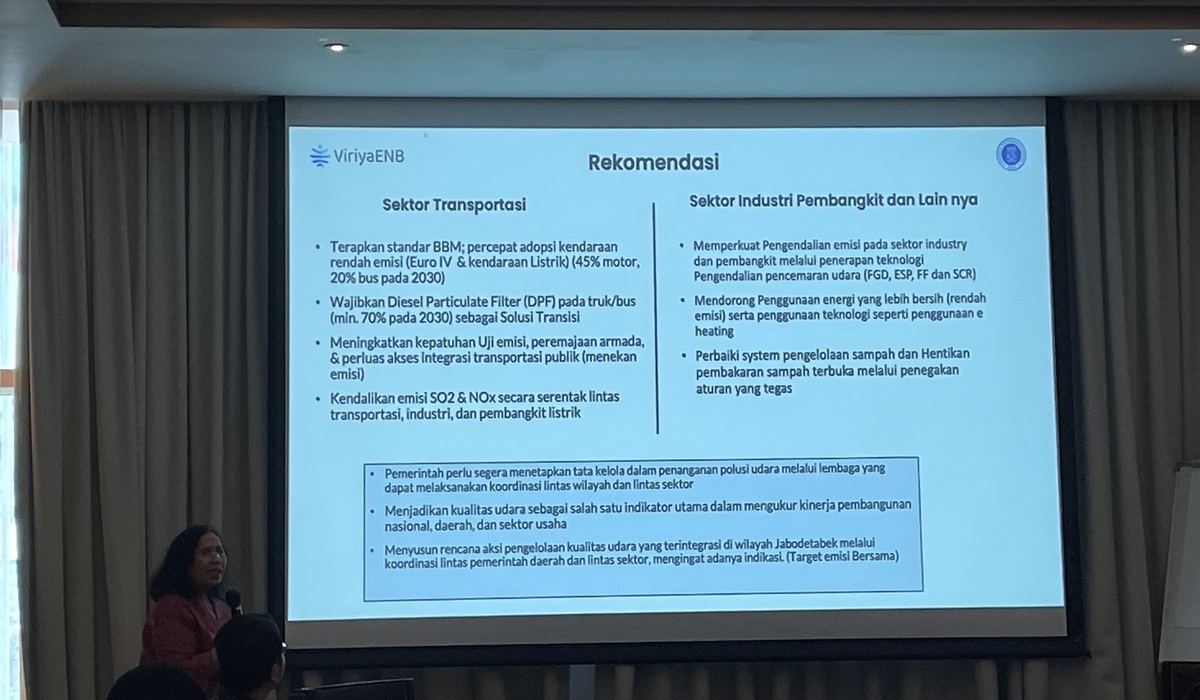
The research team from the Air and Waste Management Expertise Group (KK PUL)-FTSL-ITB at the Bandung Institute of Technology (ITB), with support from the ViriyaENB Foundation, recommended five measures.
ViriyaENB Executive Director Suzanty Sitorus said the study has mapped air pollution sources and control priorities. The government then needs to translate these findings into emission reduction targets and a clear division of responsibilities. “Jabodetabek needs a single cross-regional air quality strategy framework that can be monitored and held accountable,” said Suzanty.
Firstly, the government should immediately establish pollution control governance capable of coordinating cross-regional and cross-sectoral policies. This can be strengthened through the Agglomeration Area Council in accordance with Law Number 2 of 2024 concerning the Special Capital Region of Jakarta Province. Secondly, air quality must become a performance indicator for national, regional and business sector development.
Thirdly, emission control should be strengthened through the acceleration of low-emission vehicles, the use of low-sulphur fuel, industrial and power plant emission controls, the expansion of public transport, and the cessation of open waste burning. The government also needs to set joint emission reduction targets in Jabodetabek.
Fourthly, air quality monitoring should be strengthened and its data made transparently available so that it is easily accessible to the government, businesses and the public. Fifthly, pollution control policies must be data-based and involve academics, research institutions and civil society.