
40 Figures File Amicus Curiae, Ask for Former Ombudsman Chief’s Acquittal
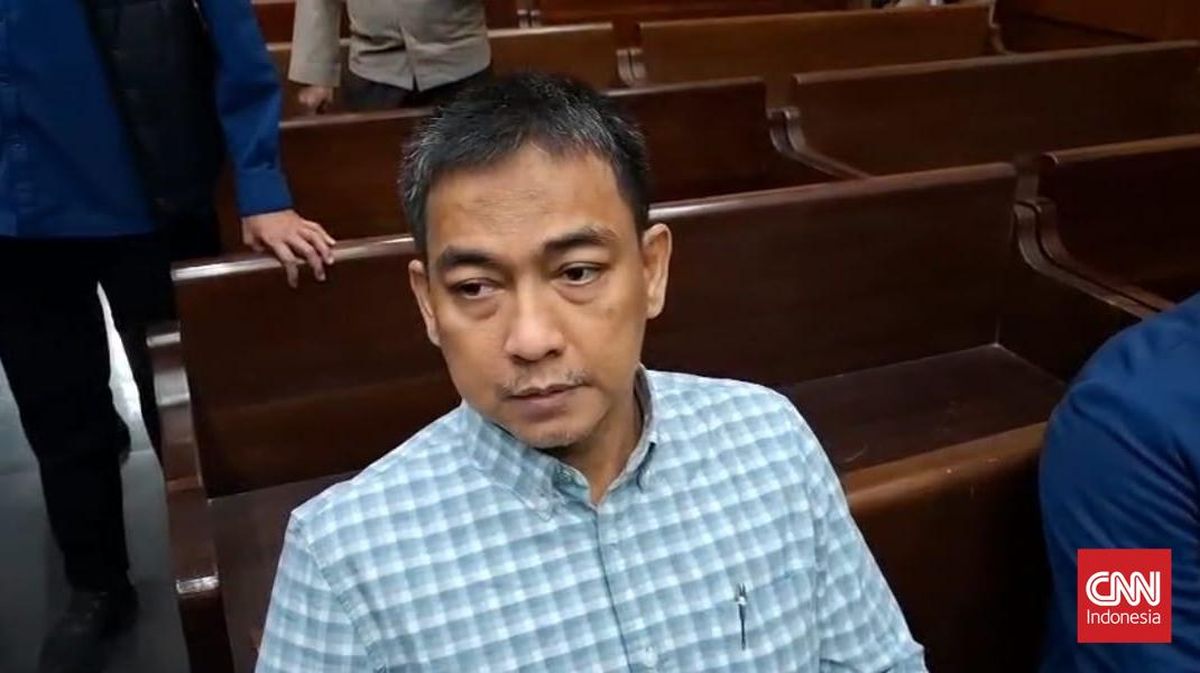
Forty national figures have submitted an amicus curiae, or “friend of the court” brief, to the panel of judges at the Central Jakarta Corruption Court in the case against former Indonesian Ombudsman chief Hery Susanto.
The legal opinion was submitted by amicus curiae spokesperson Hasrul Harahap to presiding judge Dwi Elyarahma Sulistiowati and panel members Fajar Kusuma Aji and Alfis Setiawan during a hearing on the defence’s rejoinder at the Jakarta Corruption Court on Thursday (22 October).
In the document, the figures asked the panel to examine every element of the charges against the facts established at trial and the admissible evidence. They also asked the judges to find Hery not guilty if prosecutors failed to prove the elements of the alleged offences.
Hasrul stressed that filing an amicus curiae brief was not an attempt to interfere with the judicial process, but an independent contribution of legal analysis intended to offer the judges an additional perspective.
“This amicus curiae is an effort to provide an objective legal view so that the panel can carefully assess the relationship between the trial facts, admissible evidence and the elements of the alleged offences,” Hasrul said in a statement on Thursday.
Among those who joined the submission were Fadli Nasution; Abdul Haris, rector of Tasikmalaya Islamic University for the 2022–2026 term; Hasrul Harahap, dean of the Faculty of Social and Political Sciences at Jakarta University; Dilla Novita; Suratman; Asep Supriatna; Robi Anugerah Marpaung; Derwanto; Ahmad Fauzan; and Yusak Farhan.
The figures said criminal punishment must not be based solely on assumptions, social relationships or administrative events. In their view, judges must ensure that every alleged act fulfils all the elements of a criminal offence.
They also highlighted the importance of examining the context of payments or transactions cited in the case. The existence of money or a transaction, they argued, does not by itself prove bribery.
The panel was therefore asked to assess the background and purpose of the transactions, and their connection to the alleged acts, on the basis of evidence presented at trial.
The figures also cautioned against basing criminal liability solely on friendship, communications, relationships or a person’s position.
“The point to be proved is not simply whether the defendant knew or communicated with a particular person, but whether the alleged acts have in fact been shown to satisfy the elements of a criminal offence,” the legal opinion said.
The amicus curiae authors also asked the panel to examine charges brought under Article 5, Article 12(a) and (b), and Article 606 of the Criminal Code.
They said each element of the alleged offences should be assessed in light of the principle of legality and the law in force at the time of the alleged conduct.
They also invoked the principle of in dubio pro reo, under which reasonable doubt in the evidence must be considered in the defendant’s favour.
Accordingly, they said, any conviction must be based on evidence meeting the legal standard, rather than suspicion or pressure from public opinion.
The figures asked the panel to accept and consider their legal opinion and assess all the evidence fully and independently. They also requested an acquittal (vrijspraak) if the legal requirements for such a verdict were met.
Hasrul said the submission was part of efforts to promote law enforcement grounded in evidence and the protection of defendants’ rights.
“The strength of criminal law lies in the state’s ability to prove a person’s guilt before depriving them of their liberty, not in how easily someone can be convicted,” he said.
Prosecutors have demanded a prison sentence of five years and six months for Hery, as well as a fine of Rp300 million, with 100 days’ imprisonment as a substitute if it is not paid.
Based on evidence presented at trial, the public prosecutors say Hery was proven to have been involved in corruption related to the manipulation of nickel-mining governance audit reports for the 2013–2025 period.
Prosecutors have also sought an additional order for Hery to repay Rp4.19 billion, with a three-year prison term as a substitute if he fails to pay.
The verdict is scheduled to be delivered at the Jakarta Corruption Court on 5 November.
“We will adjourn the hearing for the verdict to Thursday, 5 November 2026. We need time to deliberate,” presiding judge Dwi Elyarahma Sulistiowati said during Thursday’s hearing.