
4 in 10 Young Graduates Unemployed: The Harsh Reality of Job Hunting in India
Nearly 40%, or 1 in 4, of graduates aged 15-25 in India have yet to find employment. This is despite the country being one of the fastest-growing economies in the world.
The State of Working India 2026 report shows that university graduates account for roughly two-thirds of India’s total unemployment in 2023. Amid fierce competition for jobs, millions of young people are pinning their hopes on a handful of entrance examinations seen as tickets to decently paid employment.
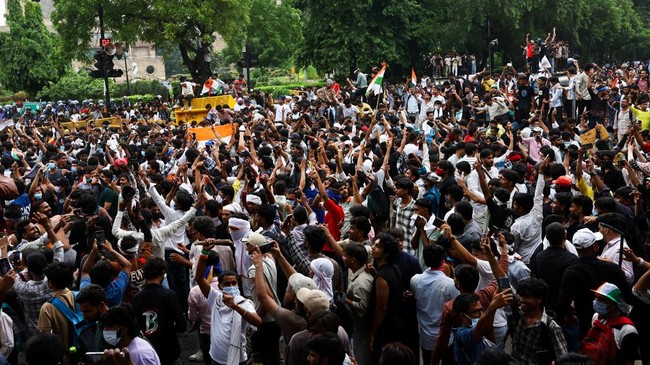
That pressure forms the backdrop to the wave of student protests that followed the leak of the National Eligibility cum Entrance Test (NEET) question papers. For many economists, the problem does not stop at the exam itself, but lies in the increasingly narrow access to stable jobs.
Job Market Not Keeping Pace with Graduate Numbers
The problem took shape long before the paper leak occurred.
Between 2004 and 2023, India produced around 5 million graduates each year. However, according to State of Working India 2026, only about 2.8 million of them manage to secure jobs annually. The number obtaining permanent salaried positions is even smaller.
As a result, the unemployment rate among graduates aged 15-25 is now approaching 40%. University graduates also account for around two-thirds of India’s total unemployment in 2023.
More and more young people are completing higher education, but the growth of quality employment has failed to keep pace.
One Exam, Millions of Hopes
Against this backdrop, entrance examinations have become far more than an educational selection process.
Millions of students compete in the National Eligibility cum Entrance Test (NEET) for places in medical faculties.
Similar competition surrounds the Joint Entrance Examination (JEE) for the Indian Institutes of Technology (IIT), the Common University Entrance Test (CUET), and the civil service examinations administered by the Union Public Service Commission (UPSC).
According to the National Testing Agency, the number of NEET participants has risen by around 50% since 2019, exceeding 2.2 million candidates in 2026.
The harder it becomes to find work, the greater the significance of a single university seat or a single position in the civil service.
When a Degree No Longer Guarantees a Future
The intense competition is reflected in the experiences of young graduates.
A graphic designer in Bengaluru said companies “pay peanuts”, whilst there is virtually no room to negotiate a pay rise because “there are hundreds of people out there” ready to take the job for less.
Similar accounts come from other graduates who say they have applied for numerous jobs without receiving any response. For many young Indians, obtaining a bachelor’s degree no longer automatically opens the door to decent employment.
Protests Triggered by an Exam, but the Problem Runs Deeper
Economists believe the paper leak was merely the trigger.
Alexandra Hermann Prasad, Lead Economist at Oxford Economics, said the fundamental problem is the limited supply of “secure, well-paid jobs” in India.
A similar view was expressed by Neelanjan Sircar, Associate Professor at Ahmedabad University. According to him, in a country where nearly one in two graduates has yet to find work, routes such as NEET represent one of the few pathways to relatively secure employment.
That is why, when the integrity of the examination is called into question, what emerges is not only anger at the selection process, but also anxiety about the future.
Economic Growth Has Yet to Transform the Labour Market
The problem has developed amid Indian economic growth that continues to draw global attention.
However, according to the State of Working India 2026 report, the expansion of higher education has not been matched by sufficiently rapid job creation.
A Bernstein report also noted that India’s economic transformation still faces challenges. Around 45% of the workforce remains employed in the agricultural sector, which contributes only about 15-16% of gross domestic product (GDP), whilst the manufacturing sector’s contribution has changed relatively little.
Bernstein also warned that developments in artificial intelligence could put new pressure on the information technology services and business process outsourcing industries, two sectors that have long served as pathways of economic mobility for young graduates.
Government Responds
Amid this pressure, India’s Education Minister Dharmendra Pradhan resigned. The government subsequently appointed Pralhad Joshi as his replacement and formed an education reform task force led by Infosys founder Nandan Nilekani.
India’s Parliament has also passed amendments to anti-paper-leak rules, introducing prison sentences of up to 10 years and fines of up to 50 lakh rupees for those involved.
For millions of India’s young graduates, the challenge now is not merely passing the exams. The real competition begins when they enter an increasingly crowded labour market, where the number of safe, decently paid jobs has not grown as quickly as the number of job seekers.
Source: jawawa.id (https://jawawa.id/newsitem/4-in-10-young-graduates-unemployed-the-harsh-reality-of-job-hunting-in-india-1785765145)
Originally published by CNBC Indonesia (https://www.cnbcindonesia.com/research/20260803172018-128-756190/4-dari-10-lulusan-muda-menganggur-begini-beratnya-cari-kerja-di-india), translated from Indonesian