
36 Countries Agree to Form Special Tribunal to Prosecute Putin
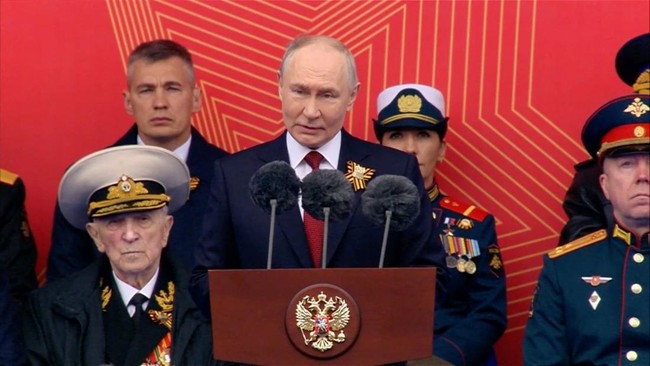
Jakarta, CNBC Indonesia - A total of 36 countries, mostly from Europe, have signed an agreement to establish a special tribunal to prosecute Russian President Vladimir Putin for alleged war crimes against Ukraine.
As reported by Euronews, the court will be based in The Hague, Netherlands. The agreement was finalised at the annual meeting of foreign ministers of the Council of Europe on Friday local time.
The European human rights organisation is the main driving force behind filling the jurisdictional gap that cannot be handled by the International Criminal Court (ICC).
The ministers also approved the structure of the special court’s governance, including the establishment of a management committee to oversee the annual budget, internal rules, and the selection of judges and prosecutors.
Ukrainian Foreign Minister Andrii Sybiha called this step an “irreversible turning point” in the long effort to seek accountability for the war in Ukraine.
“The Special Court is becoming a legal reality. Very few people believed that this day would come. But it has,” said Sybiha on social media, quoted on Saturday (16/5/2026).
“Putin always wanted to be remembered in history. And this court will help him achieve that goal. He will be recorded in history. As a criminal,” he added.
The resolution signed on Friday was signed by Andorra, Austria, Belgium, Croatia, Cyprus, the Czech Republic, Denmark, Estonia, Finland, France, Germany, Greece, Iceland, Ireland, Italy, Latvia, Liechtenstein, Lithuania, Luxembourg, Moldova, Monaco, Montenegro, Netherlands, Norway, Poland, Portugal, Romania, San Marino, Slovenia, Spain, Sweden, Switzerland, Ukraine and the United Kingdom.
Australia and Costa Rica are the only non-European countries that have signed the agreement.
The European Union also supports the initiative, although four of its member states, Bulgaria, Hungary, Malta and Slovakia, did not participate.
The list is still open for other countries, both European and non-European, to join.
The Secretary General of the Council of Europe, Alain Berset, emphasised the importance of funding and finalising regulations so that the special court can start operating soon.
The European Union has pledged an initial increase in funding of 10 million euros.
The establishment of a special court has been a pressing priority for Ukraine and its allies since the Kremlin ordered a full-scale invasion in February 2022.
The initiative is considered necessary because the ICC can only prosecute crimes of aggression if the crime is linked to a state party. Russia is not a signatory to the Rome Statute and may use its veto power in the UN Security Council to block any changes.
Unlike war crimes, crimes against humanity and genocide, which apply to individuals who commit atrocities, crimes of aggression are leadership crimes that fall on those ultimately responsible for controlling the aggressor state.