
35th NU Congress: Can Pesantren Become the Compass for the Second Century?
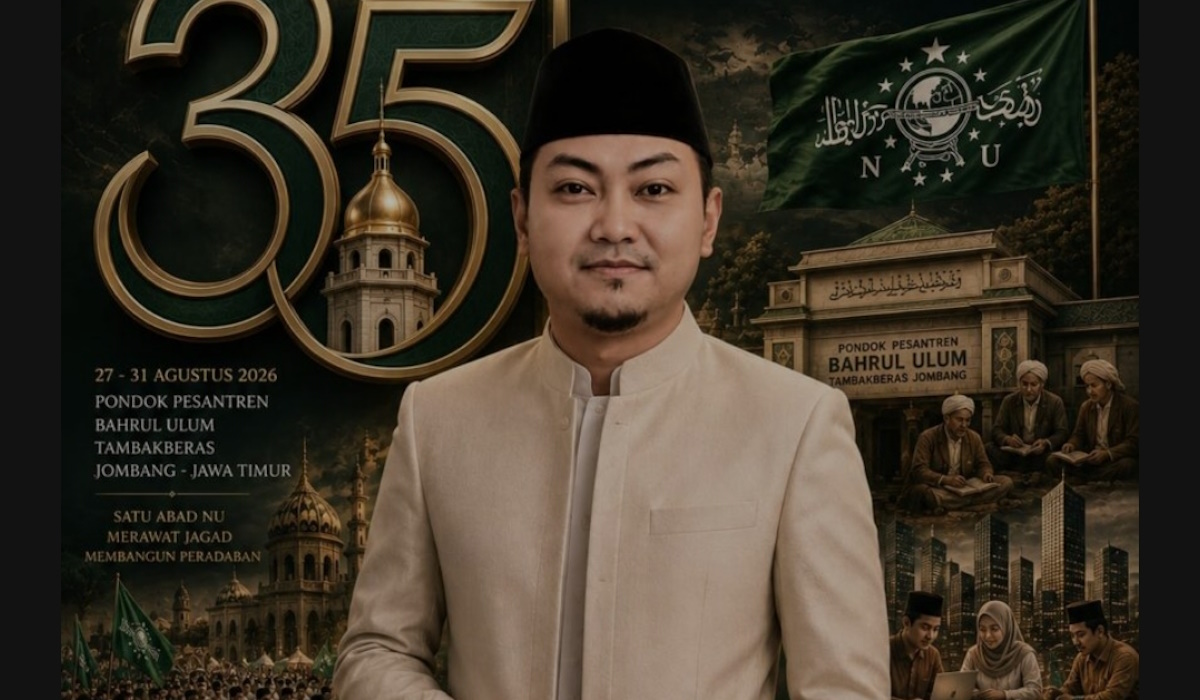
There is a symbolic message ahead of the 35th Nahdlatul Ulama (NU) Congress. The congress is being held at Bahrul Ulum Tambakberas Islamic Boarding School in Jombang, East Java, from 27 to 31 August 2026. Yet a day before the opening, public attention turned to Lirboyo Islamic Boarding School in Kediri. There, senior clerics gathered to deliver a moral message that the congress should proceed with dignity, democracy and honesty, free from pressure, provocation and strife. Their message was simple: safeguard the honour of NU, exercise rights responsibly, and do not allow contestation to damage fraternity.
From this emerges a question larger than merely who is elected: is NU still capable of making the pesantren a moral compass as it enters its second century? Lirboyo is not the venue of the 35th Congress. However, the message born from that pesantren carries significant meaning for NU’s journey. The forum of senior clerics on 26 August 2026 stressed the importance of preserving the honour of the organisation and avoiding pressure and conflict.
A congress is not merely a mechanism for leadership succession. It is a moment to determine the direction of NU’s journey. In the pesantren tradition, victory is not the only measure. There is adab, akhlak, respect for knowledge, and ukhuwah. Therefore, a congress may be an arena of differing choices, but it must not turn into an arena of enmity. Contestation may end within days, but NU’s fraternity must be preserved for decades, even centuries.
The public certainly wants to know who will become Rais Aam and General Chairman of the NU Executive Board for the 2026–2031 term. But the more strategic question is: for what purpose will the organisation’s power be used? NU does not only need a contest winner. NU needs leadership capable of turning differences into strength, conflict into reconciliation, tradition into innovation, and the large number of nahdiyin into a real force for the nation’s benefit.
KH Ma’ruf Amin emphasised the importance of managerial and technocratic capacity for candidates for General Chairman of the NU Executive Board, as well as the ability to carry out the function of al-islah: reconciling differing parties and uniting NU’s potential. Future NU leadership is not enough if it only possesses personal piety. It must have intellectual, managerial, technocratic and reconciliatory capacity.
The challenges of NU’s second century differ from the past. The world is moving towards a digital society. Artificial intelligence is beginning to change education, the economy, media, work, and even the way people form opinions. NU’s younger generation does not only grow up in mosques and pesantren. They live on TikTok, learn through YouTube, communicate through WhatsApp, obtain information from algorithms, and are beginning to interact with AI.
The question is: can NU enter this new world without losing its identity? The answer cannot simply be to cite the large number of NU members. Numbers do not automatically become strength. Strength is born when the scholarly tradition of the pesantren meets technological proficiency. The pesantren of the future is not enough if it only produces students able to read classical texts. It must also produce scholars who understand technology, intellectuals who understand religion, technocrats with moral character, and a digital generation that still maintains scholarly chains of transmission.
The more advanced technology becomes, the more humanity needs a moral compass. AI can produce information, but it does not automatically produce wisdom. Algorithms can determine what appears on screen, but they must not determine what we believe. Social media can make someone viral, but virality is not identical to truth. NU does not need to choose between tradition and technology. The more appropriate choice is tradition that guides technology.
The pesantren possesses important assets: talaqqi, scholarly chains of transmission, tabayyun, adab, respect for scholars, and discipline in acquiring knowledge. These values are increasingly relevant as society faces information overload, disinformation, deepfakes, digital manipulation and the development of AI. The digitalisation of pesantren must not stop at installing internet access or using learning platforms. What is more important is building a knowledge ecosystem that makes technology submit to human values and the common good.
Pesantren must not continue to be placed as objects of policy. Going forward, pesantren must become subjects of civilisation—able to speak about education, the economy, health, the environment, food security, technology, AI, the digital economy, the future of work, and Indonesia 2045. This does not mean pesantren should lose their identity. On the contrary, the wider the problems faced, the more important it is for pesantren to maintain their scholarly roots.
Pesantren do not have to become technology universities. However, they must be able to produce people who are technologically literate and morally mature. The modern world needs people who not only know how to use technology, but also understand what technology is used for. If there is one word worthy of being the spirit of the 35th Congress, that word is reconciliation.
Reconciliation does not mean everyone must think alike. NU has grown precisely because it is able to manage differences. What must stop is when differences turn into enmity, criticism into slander, political choices into group fanaticism, and contestation into a scramble for influence. The message of the senior clerics from Lirboyo should be read as a moral message for all nahdiyin, not only congress participants: do not bring group ego into the great house of NU. After the contestation ends, all parties remain in the same house.
NU’s younger generation is waiting for an answer. They do not much care who argues loudest in elite circles. They want to know whether NU is able to provide solutions to life’s problems: job competition, education costs, disruption.