
3 kg CNG Cylinders to Replace LPG, Initial Imports from China
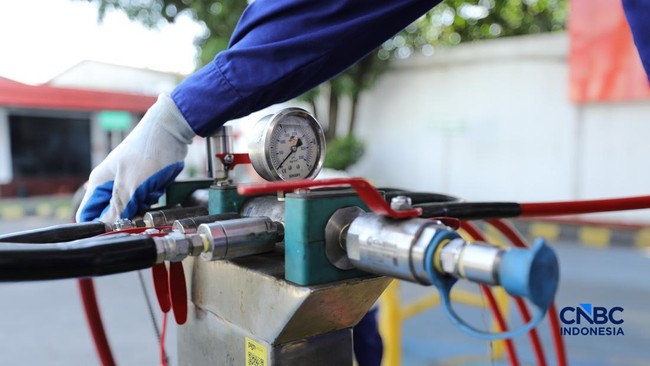
The Ministry of Energy and Mineral Resources (ESDM) is currently finalising the distribution scheme for 3kg Compressed Natural Gas (CNG) as an alternative to Liquefied Petroleum Gas (LPG). The 3kg CNG packaging will be marketed through the official agent and base network of PT Pertamina (Persero), adopting a distribution pattern similar to the existing LPG system.
The Director General of Oil and Gas at the Ministry of ESDM, Laode Sulaeman, stated that the distribution of 3kg CNG will utilise the same mechanism as LPG to ensure ease of implementation for the public.
“Where there is an agent function, there is a base function; this must be coordinated with Pertamina. The pattern implemented for CNG will be exactly like one of the forms of the LPG distribution pattern,” Laode explained recently.
Laode further explained that the public will not need to purchase the CNG cylinders. The government will implement a gas refill exchange system, while the ownership of the cylinders remains with the providing business entities.
“The pattern for the cylinders is that they will not be purchased by the public, but will belong to the business entities. Therefore, the public will simply exchange them,” he emphasised.
For the initial implementation phase, the government has decided to import CNG cylinders from China. This step is being taken because the technology required to manufacture high-pressure cylinders is not yet mass-produced domestically.
According to Laode, CNG cylinders have much more complex technical specifications compared to LPG cylinders, as they must be capable of withstanding gas pressures of up to 200-250 bar.
The cylinders to be used will be Type 4, made from fibre-based materials. Compared to steel or Type 1 cylinders, Type 4 cylinders are much lighter yet still capable of withstanding high pressure, making them considered safer and more efficient for CNG distribution.
The Ministry aims to place the first order for pilot project requirements in the near future. The government requires large-scale orders to ensure supply continuity before a technology transfer process for domestic production can be undertaken.
“The minimum order is around 100,000 units. That is why, if anyone asks why they haven’t been manufactured yet, it is because we must order 100,000 or more first,” he concluded.