
28,000 University Students from Multiple Disciplines Targeted for AI Training
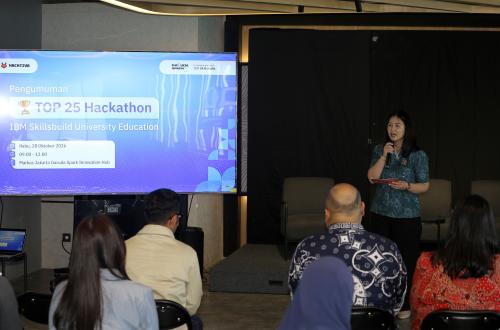
JAKARTA — A total of 28,000 students from universities across Indonesia are targeted to master artificial intelligence (AI) skills by 2027. The digital talent development programme is aimed not only at information technology students but also those in other disciplines, including law and healthcare, as demand grows for workers able to use AI across industry sectors.
As of October 2026, more than 14,200 students had taken part in the free, structured AI training programme. Participants receive instruction in Indonesian through comprehensive training, online and in-person workshops, and practical exercises in using AI to develop software and independently create technological solutions.
Hacktiv8 CEO Juventia Vicky Riana said the rapid adoption of AI by companies in Indonesia must be matched by improvements in the quality of human resources. Mastery of the technology is increasingly important, she said, because AI is no longer used solely in the information technology industry.
“Businesses in Indonesia are adopting AI rapidly. It is therefore very important to have a skilled workforce with a growth mindset,” Juventia said in Jakarta on Wednesday (28 October 2026).
She said developing AI skills required more than theoretical understanding. Students also needed practical experience in creating innovations that could be applied to solve problems in a range of fields.
The programme therefore includes a hackathon, giving students the opportunity to develop technology-based solutions. The curriculum covers agentic AI, an approach that enables systems to carry out a series of tasks more independently in order to achieve a specific goal.
Of more than 200 hackathon participants, 25 were selected for the semi-final, which is supported by Garuda Spark. The competition gives participants a chance to test their ability to turn AI knowledge into innovations with real-world potential.
Mizan Lazuardi, head of partnerships at the Garuda Spark Innovation Hub (GSIH) at the Ministry of Communication and Digital Affairs (Kemkomdigi), said technology skills development needed to be accompanied by an ecosystem that could help student innovations grow into startups.
The government’s support, Mizan said, went beyond providing training and workspace. Garuda Spark is also intended to serve as an innovation incubator, helping startups develop products and improve their prospects of entering the market.
“When participants graduate from the incubation programme, we have Startup Studio Indonesia as an accelerator. We also have the Hub.id programme, which is a national programme,” Mizan said.
He said the startup development ecosystem involved hundreds of mentors with expertise in different industry sectors. The support is designed to help participants address technical, business and regulatory challenges as they develop their innovations.
“If they need a technical IT, legal, tax, healthcare or manufacturing mentor, we have people for that,” Mizan said.