
25,000 University Students in Greater Bandung Mobilised to Cut Waste at Source by 20%
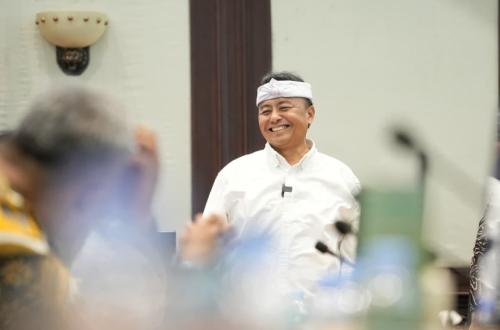
The West Java Provincial Government and Bandung City Government are strengthening waste management from source to disposal, with a target of reducing waste at source by 20 per cent. One planned measure is to mobilise 25,000 university students to educate residents in 50 districts across Greater Bandung.
West Java Regional Secretary Herman Suryatman said the initiative followed instructions from West Java Governor Dedi Mulyadi for the provincial and regency and city governments to strengthen cooperation in addressing strategic issues, particularly waste and the management of road reserves.
Herman made the remarks after co-ordinating with Bandung Mayor Muhammad Farhan at Bandung City Hall on Thursday (15 October 2026). He said the challenges in Greater Bandung required a structured, systematic and large-scale response. Alongside waste, the government also faced the challenge of removing illegal buildings, which needed to be balanced with risk mitigation and measures to empower communities.
“It cannot be done by feeling; it must be by design. The heart must be present, and so must logic. In other words, empirical and scientific approaches must be blended,” Herman said.
He stressed that leaders must set an example and be supported by cohesive bureaucratic governance down to district and subdistrict level. This would ensure that adopted policies could be translated into concrete action on the ground.
Herman said Bandung and the wider Greater Bandung area faced complex waste-management challenges. Existing innovations, including Gaslah and other waste-management programmes, needed to be reinforced by greater public participation and stronger waste-handling capacity at local level.
One practical measure being prepared by the West Java Provincial Government is to make greater use of universities. Herman said it had been in communication with the Region IV Higher Education Service Institute (LLDIKTI) to mobilise students from around 90 universities in Greater Bandung.
The programme aims to involve 25,000 students, who will work with district heads, subdistrict heads, neighbourhood association (RW) administrators and other community representatives in 50 districts across Greater Bandung. Twenty-six of the districts are in Bandung, with the remainder spread across the wider region.
The students will educate residents directly, particularly on reducing food waste, sorting waste, reusing materials and recycling household waste.
Herman cited the success of waste management in Arcamanik district, Bandung, which had previously served as a pilot for collaboration between the government and universities. For three months, students from the Islamic University of Bandung (Unisba) worked in the area and supported local residents.
As a result, Herman said, waste volumes in Arcamanik fell by about 20 per cent, while the amount of sorted waste doubled. The experience will be replicated in other districts across Greater Bandung.
“If we replicate and strengthen the Arcamanik experience together, God willing, we are optimistic that a 20 per cent reduction in waste at source can be achieved,” he said.
Herman said the target could have a significant impact, given that Greater Bandung is estimated to generate 5,000 tonnes of waste a day. A 20 per cent reduction could mean around 1,000 tonnes a day no longer entering the downstream waste-management system.
“However much technology we prepare downstream, we must strengthen our ability to reduce waste at source. The best waste management is to reduce, reuse and recycle waste from the household,” Herman said.
Downstream, the West Java Provincial Government is also preparing measures to ensure the continued operation of the Sarimukti Final Processing Site (TPA).
Herman said the government had co-ordinated and conducted studies with various parties, including universities, to mitigate risks and optimise the facility’s capacity.
One planned measure is to compact the waste, with the work scheduled to continue until December 2026. A technical study has been conducted with the Bandung Institute of Technology (ITB), taking into account the potential for methane gas and safety considerations.
The West Java Provincial Government also plans to build two gravity walls at Sarimukti to reinforce the waste piles and reduce the risk of landslides. Procurement is expected to proceed so construction can begin in early 2027.
The government is also mitigating increased leachate at a new zone and seeking technical support from the Ministry of Environment. In addition, it is exploring pyrolysis technology to turn waste into fuel in co-operation with the Indonesian Army, while plans to produce refuse-derived fuel (RDF) from waste with the private sector are being finalised.
Herman stressed that downstream measures must go hand in hand with reducing waste at source. Waste management cannot rely solely on building facilities or deploying technology; it requires the involvement of all levels of government, universities, businesses and the public.
By strengthening co-ordination across governments, involving universities and changing public behaviour, the West Java Provincial Government hopes to improve waste management in Greater Bandung and ease pressure on the Sarimukti landfill.
Source: jawawa.id (https://jawawa.id/newsitem/25-000-university-students-in-greater-bandung-mobilised-to-cut-waste-at-source-by-20-1792140922)
Originally published by Republika (https://rejabar.republika.co.id/berita/tmzquu423/25-ribu-mahasiswa-di-bandung-raya-digerakkan-untuk-kurangi-20-persen-sampah-dari-hulu), translated from Indonesian