
23 Supreme Court and Ad Hoc Judge Candidates Undergo Final Interview Selection
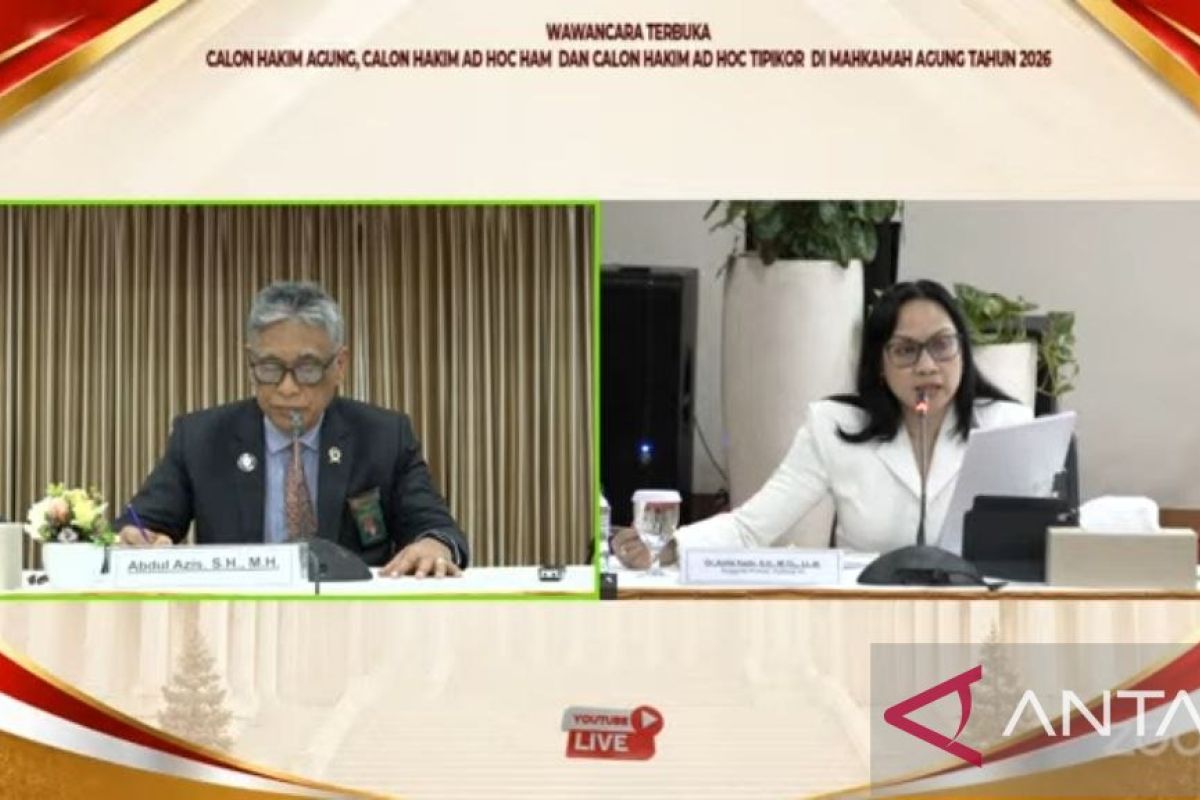
Jakarta (ANTARA) — A total of 23 candidates for Supreme Court justice and ad hoc judge positions for 2026 are taking part in the final-stage interview selection at the Constitutional Court, to be held in stages from Monday.
The candidates consist of 19 prospective Supreme Court justices, two prospective ad hoc judges for human rights, and two prospective ad hoc judges for corruption offences.
The 19 candidates for Supreme Court justice, based on their chambers, comprise nine for the criminal chamber, four for the civil chamber, three for the religious affairs chamber, and three for the special tax administrative chamber.
This interview selection is the final stage of the recruitment process for Supreme Court justices and ad hoc judges for the 2026 period.
Speaking at the opening of the interview selection at the Judicial Commission, its Chairman Abdul Chair Ramadhan said the selection is being held to fill vacant positions for justices and ad hoc judges at the Supreme Court, comprising 11 justice positions: two in the civil chamber, four in the criminal chamber, two in the religious affairs chamber, three in the special tax state administrative chamber, two ad hoc justices for human rights, and one ad hoc justice for corruption offences.
The Judicial Commission has carried out a series of eligibility tests, including a quality selection held on 5–6 May 2026, followed by health and personality tests conducted between June and July.
“From today through the next five days, from 3 to 7 August, open interviews will be held as the final stage of the entire selection process for candidates for Supreme Court justice and ad hoc judges for human rights and corruption at the Supreme Court,” said Abdul.
According to him, the interview selection aims not only to test the individual capacity, experience and competence of the candidates, but also to explore their integrity, independence, leadership and commitment, particularly in relation to law enforcement and their sensitivity to the values of justice that live and develop in society.
The Judicial Commission will subsequently determine which candidates for Supreme Court justice and ad hoc judges for human rights and corruption offences pass, based on the results of the open interviews and taking into account the results of previous eligibility test stages.
At the time this report was filed, the open interview selection for the candidates was still under way.
The first day of selection was attended by four candidates, who were assessed by a panel comprising seven Judicial Commission members, one statesman and one legal expert.
In the open interview selection, the panellists will explore the candidates’ vision, mission, commitment, statesmanship, integrity, legal and judicial knowledge, and technical competence relating to their mastery of formal and substantive law.
The four candidates attending the final interview selection today were Abdul Azis, candidate for the criminal chamber, currently serving as Deputy Chief Judge of the Pekanbaru High Court; Bambang Myanto (Director General of the General Judiciary Body at the Supreme Court); Dhifla Wiyani (advocate at DW and Partners); and Nirwana (Chief Judge of the Makassar High Court).