
210 Foreign Nationals Suspected of Online Scam and Investment Fraud, Most Entered Indonesia...
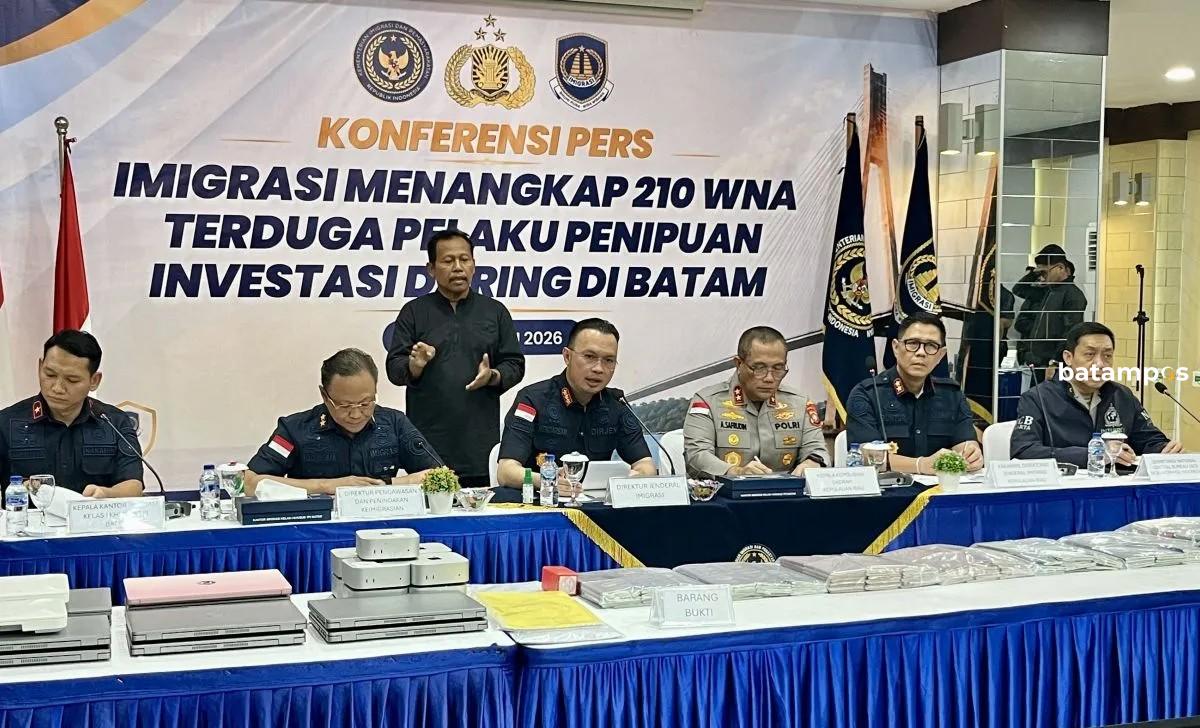
The Directorate General of Immigration, in collaboration with the Riau Islands Regional Police, has uncovered an alleged international online investment scam operating in Batam, Riau Islands. In a joint operation conducted on Tuesday, 6 May, authorities secured 210 foreign nationals from two different locations suspected to be the hubs of the network’s activities. The revelation of this case adds to the long list of suspected cross-border cybercrimes that exploit Batam as an operational base. In addition to its strategic location on international routes, the industrial city is considered to have high mobility of incoming and outgoing foreigners. Director General of Immigration Hendarsam Marantoko stated that the operation was carried out after authorities received information about suspicious activities by several foreign nationals at the Baloi View Apartment since mid-April 2026. Covert surveillance was then conducted for nearly four weeks before the joint team moved in to take action. “We, together with the police, conducted early detection and secured 210 foreigners suspected of being involved in online investment scams,” said Hendarsam on Friday, 8 May. Of the total foreign nationals secured, 125 are Vietnamese nationals, 84 are Chinese nationals, and one is a Myanmar national. They consist of 163 men and 47 women. All the foreign nationals are now placed in the detention room at the Class I Special Immigration Office for Batam International Checkpoint to undergo further examination. Authorities are still investigating the possibility of other criminal acts beyond immigration violations. Hendarsam said that if the examination results only find immigration administrative violations, the foreign nationals will be subject to deportation and blacklisting. However, if other criminal elements are found, the case will be handed over to law enforcement authorities. Director of Immigration Supervision and Enforcement Yuldi Yusman explained that the joint team, consisting of around 60 personnel, moved to two locations on 6 May 2026 at around 06:00 WIB. In addition to the Baloi View Apartment, officers also raided a house in an elite residential area in Batam. According to Yuldi, the location was suspected to have been systematically prepared to support the operational activities of the online scam network. “At the location, a fairly structured operational pattern was found. The ground floor was used as a workspace, floors two to four as living quarters, and the fifth floor was prepared as an operations control room,” he said. During the raid, officers seized various electronic devices suspected of being used to carry out the scam activities. The evidence secured included 131 all-in-one computers, 93 laptops, 492 mobile phones, and 198 passports. Based on initial examinations of the electronic devices, the foreign nationals were suspected of running online investment scams using methods of stock and digital asset trading. Authorities suspect victims come from several countries in Europe and Vietnam. Immigration also found that most of the foreign nationals entered Indonesia using visit stay permits. Fifty-seven people are recorded as using the visa-free visit facility, 103 used visa on arrival, 49 used B1/B2 visit visas, and one had an investor stay permit. According to Yuldi, the presence of hundreds of foreign nationals with temporary stay permits in one permanent residential location is deemed inconsistent with the purpose of the stay permit issuance. “We are still investigating the possibility of other parties involved, including supporting networks in Indonesia,” he said. Nevertheless, to date, authorities claim they have not found any involvement of Indonesian nationals in the activities. Immigration suspects the foreign nationals violated Article 75 Paragraph 1 of Law No. 6 of 2011 on Immigration regarding activities that endanger public security and order. Authorities are also open to applying other criminal articles if elements of fraud, money laundering, or cross-border cybercrime are found in the case development.