
2027 State Budget Deficit Maintained at 2.4% Despite Increased Spending
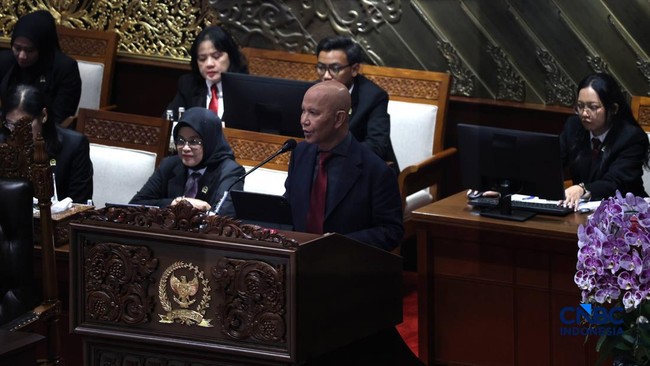
The Government and the House of Representatives (DPR) agreed on the 2rag2027 Draft State Budget (RAPBN) posture during a plenary session on Tuesday (29/09/2026). This was confirmed by the Head of the DPR Budget Committee, Said Abdullah.
Under this agreed structure, state revenue is projected at Rp 3,445.10 trillion, comprising tax revenue of Rp 2,911.95 trillion. Tax revenue is further divided into Rp 2,593.35 trillion from taxes and Rp 318.60 trillion from customs and excise. Additionally, non-tax revenue (PNBP) is estimated at Rp 522.48 trillion, with grants amounting to Rp 66 billion.
State expenditure is set at Rp 4,106.26 trillion, consisting of central government spending of Rp 3,371.26 trillion. This includes Ministry/Agency (K/L) spending of Rp 1,556.89 trillion and non-K/L spending of Rp 1,814.36 trillion.
Furthermore, transfers to regions (TKD) have been agreed at Rp 735 trillion. Consequently, the balance shows a deficit of Rp 20.85 trillion, with the total state budget deficit reaching Rp 671.16 trillion. This deficit is equivalent to 2.4% of the state budget, with budget financing pegged at Rp 671.61 trillion.
Said noted that while state revenue is expected to increase in 2027, this will not alter the overall budget deficit target. “We are maintaining the deficit target at 2.4% of GDP to ensure the 2027 Draft State Budget fulfils its budgetary function while adhering to the principle of prudence,” he explained.
He added that this increase in spending will be accompanied by the responsibility to raise state revenue targets through two pillars: taxes and non-tax revenue (PNBP). “Thus, the increase in state expenditure will not burden debt financing,” he said.
Furthermore, the responsibility for increasing revenue targets, particularly taxes, rests on improving governance, utilising technology, law enforcement, and natural tax growth. “The expansion of the tax base must be handled carefully so as not to burden the economic life of the people,” Said emphasised.
Said stated that the increase in spending must be measurable in terms of both output and outcomes across various sectors. Regarding transfers to regions (TKD), the government and Parliament agreed that the central government will cover the salaries and honorariums for PPPK (government employees with work agreements) working in regional environments, including teachers and healthcare workers, amounting to Rp 23 trillion. “This budget will reduce the burden on regional governments,” he noted.
Meanwhile, regarding the financial relationship between regional and central governments, the budget establishes mandatory spending for personnel expenses at 30% and infrastructure spending at 40%, to be implemented no later than the enactment of the relevant law. “From the evaluation of these mandates, we have agreed to postpone the mandatory spending requirements to protect regional fiscal space,” he concluded.