
2027 Investment Target of 7%: Danantara Cannot Yet Be the Booster
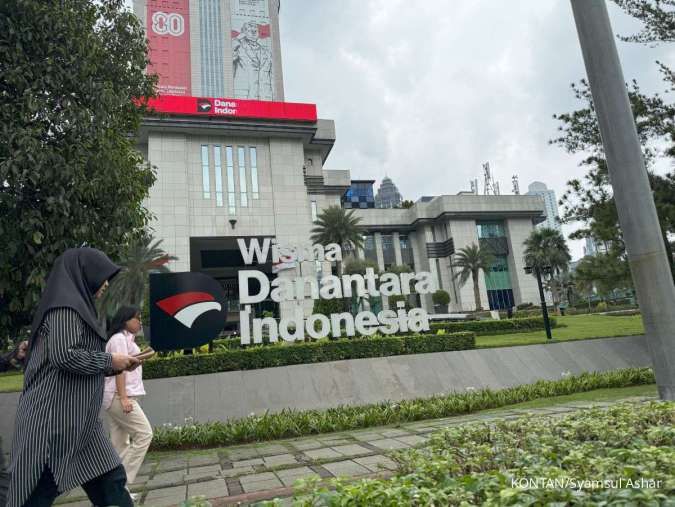
The Center of Reform on Economics (CORE) Indonesia assesses that the target for Gross Fixed Capital Formation (GFCF) or national investment growth of 6.5%-7% in 2027 is still achievable. However, the government needs to accelerate investment realisation amidst a slowing momentum that has become apparent throughout this year.
CORE Indonesia Economist Yusuf Rendy Manilet stated that the lower bound of the target is still realistic. However, to reach the upper bound, the pace of investment must grow higher than current conditions.
“I see the lower bound as still quite realistic, but the upper bound will be difficult to achieve without accelerating investment. Currently, GFCF is still growing at 5.96% annually. It is indeed the second largest contributor to growth after household consumption, but to reach 6.5%-7% in 2027, the pace of investment must increase faster than it is now,” Yusuf told Kontan on Tuesday (30/6/2026).
“The investment value is indeed still large, but the momentum is starting to slow. Yet the 2027 GFCF target requires an acceleration of investment,” he said.
Yusuf assessed that the problem with investment in Indonesia is not solely the size of the incoming investment value, but also its effectiveness in driving economic growth. Currently, the ratio of GFCF to gross domestic product (GDP) is still around 28%, while Indonesia’s Incremental Capital Output Ratio (ICOR) remains in the range of 5-6.
“This means that every additional unit of investment has not yet produced optimal economic growth. What is needed is not just more projects, but more productive investment through regulatory improvements, business certainty, and lower logistics costs,” he explained.
Regarding the role of the Daya Anagata Nusantara Investment Management Agency (Danantara), Yusuf assessed that the institution has the potential to become one of the drivers of investment. However, its impact on GFCF growth is expected to only become visible towards the end of 2026 to 2027, given that most projects are still in their early stages.
He also cautioned against equating the value of investment commitments with investment realisation. According to Yusuf, a portion of the funds managed by Danantara is still being used for the restructuring of state-owned enterprise (SOE) assets, so not all of it is immediately recorded as gross fixed capital formation.
“The announced investment value is indeed large, but not all of it is directly recorded as GFCF. Some is used for restructuring SOE assets, which is important for governance but does not immediately create new investment,” he said.
Furthermore, Yusuf assessed that Danantara’s success is not only measured by the amount of funds disbursed, but also by its ability to attract private sector participation.
“If investment is still dominated by government and SOE funds, the impact on the economy will be limited. Its success is actually measured by how much private investment comes in, or crowding in. That will determine whether Danantara truly becomes an investment catalyst or merely a new source of state financing,” he said.
From a sectoral perspective, Yusuf estimates that investment in 2027 will still be supported by downstream processing projects and infrastructure development. The base metals industry is expected to remain the main contributor, followed by downstream oil and gas projects, bioethanol, bioavtur, dimethyl ether (DME), and waste-to-energy processing.
On the other hand, investment in the digital economy and renewable energy is also expected to continue increasing, particularly through the construction of data centres. However, its contribution is considered not yet as large as investment in the industrial downstream sector.