
2027 Hajj Cost Proposed at Rp107.3 Million, Pilgrims to Pay 40%
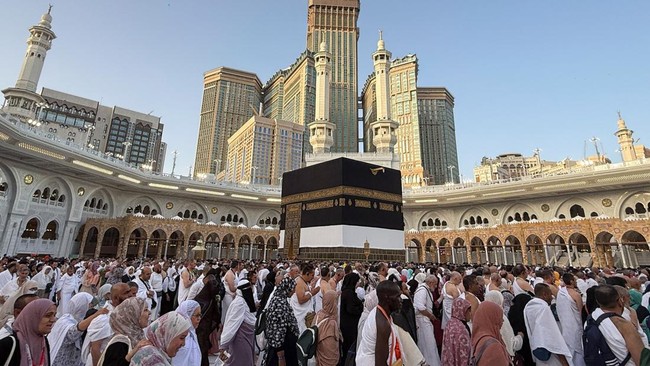
The government has proposed an average Hajj pilgrimage cost (BPIH) for 1448 H/2027 M of Rp107.34 million per pilgrim. Of this total, the portion paid directly by pilgrims through the Hajj Travel Cost (Bipih) is proposed at 40%.
The proposal was delivered by Minister of Hajj and Umrah Mochamad Irfan Yusuf during a working meeting with House Commission VIII at the Parliament Building in Senayan, Jakarta, on Wednesday (19/8/2026).
Under the scheme proposed by the government, regular Hajj pilgrims would pay a Bipih of Rp42.94 million, or 40% of the total BPIH. Meanwhile, 60%, or approximately Rp64.40 million, would be covered through the benefit value funds managed by the Hajj Financial Management Agency (BPKH).
“The government always considers the principles of efficiency and effectiveness in determining the BPIH components, so that the Hajj pilgrimage can be carried out properly at a reasonable cost,” Irfan said in his presentation.
In preparing the 2027 BPIH proposal, the government used an assumption of an Indonesian Hajj quota of 221,000 pilgrims. This quota consists of 203,320 regular Hajj pilgrims, including pilgrims, Regional Hajj Officers (PHD), and Hajj and Umrah Guidance Group (KBIHU) supervisors, as well as 17,680 special Hajj pilgrims.
The government also used a number of macroeconomic assumptions in calculating the 2027 Hajj cost requirements. One of these is the rupiah exchange rate against the US dollar of Rp17,500/US$ and the Saudi riyal exchange rate of Rp4,666.67/SAR.
The allocation for living costs for pilgrims is proposed to remain at SAR750 per pilgrim. This component will be charged through the benefit value funds.
Irfan said the 2027 BPIH calculation also took into account various external dynamics, especially global geopolitical conditions, energy prices, rupiah exchange rate movements, and changes to Hajj services in Saudi Arabia.
According to him, increases in world oil and avtur prices could put pressure on flight costs. The impact would be even greater if the rupiah weakened.
“Global geopolitical dynamics affect the organisation of the Hajj pilgrimage, with impacts on increases in world oil and avtur prices as well as exchange rate volatility. An increase in avtur prices accompanied by an adjustment in the rupiah exchange rate could significantly increase air transport costs in rupiah,” he explained.
In terms of services in Saudi Arabia, the government also noted changes to the Masyair service package for the 1448 H/2027 M Hajj season. The Saudi Arabian government is said to have eliminated the Masyair package D service. As a replacement, the Indonesian government plans to use the Masyair package C service.
In addition to regular Hajj, the Ministry of Hajj and Umrah proposed a financing allocation for special Hajj sourced from the optimisation of benefit value from initial deposits and full payments. The proposed value reaches Rp8.39 billion. These funds will be used to support the provision of equipment, travel documents, guidance for special Hajj pilgrims in the country, and general services.
After the government delivered the BPIH proposal, the Ministry of Hajj and House Commission VIII agreed to form a BPIH Working Committee for 1448 H/2027 M. The committee will discuss all cost components in more detail before the final BPIH and Bipih amounts to be paid by pilgrims are determined.
“We express our highest gratitude and appreciation to House Commission VIII for supporting the work of the Ministry of Hajj. The proposal will be discussed together,” Irfan concluded.
Thus, the figure of Rp107.34 million is still a government proposal and is not yet the final Hajj cost. The 2027 BPIH and Bipih amounts will be determined after further discussion between the government and the House of Representatives through the BPIH Working Committee.