
2027 Draft State Budget Macro Assumptions: Rupiah at Rp17,500/US$, 2.4% Deficit
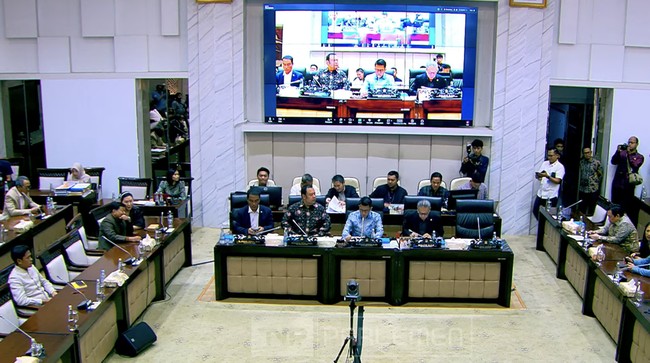
Jakarta, CNBC Indonesia - Commission XI of the House of Representatives (DPR) RI, the government, and Bank Indonesia (BI) have reached an agreement on the basic macro-economic assumptions, development targets, and development indicators for the 2027 Draft State Budget (RAPBN) on Wednesday (2/9/2026).
The government was represented by Minister of Finance Purbaya Yudhi Sadewa, Minister of National Development Planning (PPN) Rachmat Pambudy, and the Head of BPI Danantara Rosan P. Roeslani. Meanwhile, Bank Indonesia was represented by the Interim Governor of BI, Destry Damayanti. The details of the macro assumptions and development targets are as follows:
Macro Assumptions:
Economic Growth: 6%
Inflation: 2.5%
Rupiah Exchange Rate: Rp17,500
10-Year SBN Interest Rate: 6.9%
State Budget (APBN) Deficit: 2.4% or Rp671.2 trillion
Development Targets and Indicators:
Poverty Rate: 6%-6.5%
Extreme Poverty: 0%-0.5%
Gini Ratio: 0.360-0.365
Open Unemployment Rate (TPT): 4.30-4.87%
Human Capital Index: 0.575
Farmer Welfare Index: 0.8038
Farmer Terms of Trade (NTP): 126-128
Fisherman Terms of Trade (NTN): 106-110
Proportion of Formal Employment: 40.81%
New Job Creation: 2.57 million - 3.49 million people
GNI per capita (USD): US$ 5,800 - US$ 5,840
GNI per capita (IDR): Rp 98.54 million - Rp 99.22 million
Environmental Quality Index: 76.84
Regarding economic growth, the Chairman of Commission XI of the DPR RI, M. Misbakhun, stated that the determination of these economic growth assumptions has considered both global and domestic economic conditions, as well as various opportunities and risks affecting national economic performance.
“Furthermore, the setting of these assumptions has considered the effectiveness of the policy mix involving fiscal, monetary, and financial sectors in maintaining stability while simultaneously driving economic activity,” Misbakhun emphasised.
In this regard, the government is also required to sharpen its strategies and strengthen policy effectiveness to achieve the set economic growth targets from the expenditure side, including investment at 7%, exports at 7.5%, imports at 8.5%, household consumption at 5.4%, and government consumption at 5.6%.
The DPR also encouraged the presentation of contributions from ministries/agencies, including BPI Danantara, towards economic growth and the national development agenda. BI and OJK must also strengthen policy implementation to drive economic growth, particularly in strategic sectors, and increase public income.
Misbakhun also noted in the decision that the government must ensure that the deficit and national debt remain within safe limits, demonstrated through prudent, accountable, transparent, and innovative management, underpinned by the principle of caution, so that the State Budget (APBN) drives growth while maintaining fiscal sustainability.
The DPR also emphasised that the management of the Excess Budget Balance (SAL) must remain prudent and optimal as a buffer instrument to face fiscal uncertainty and risks.
During this working meeting, Misbakhun also asserted that Commission XI will provide recommendations to the Ministry of Finance to conduct fiscal risk assessments and adjustments to APBN policies to ensure fiscal sustainability, the effectiveness of the APBN as an economic stabilisation instrument, and the achievement of development targets.