
2026 Nobel Chemistry Laureates Solve the Mystery of ‘Handedness’
Stockholm (ANTARA) — Hold up both your hands. They look almost identical and are mirror images of each other. Yet however you turn them, your left hand can never perfectly overlap your right.
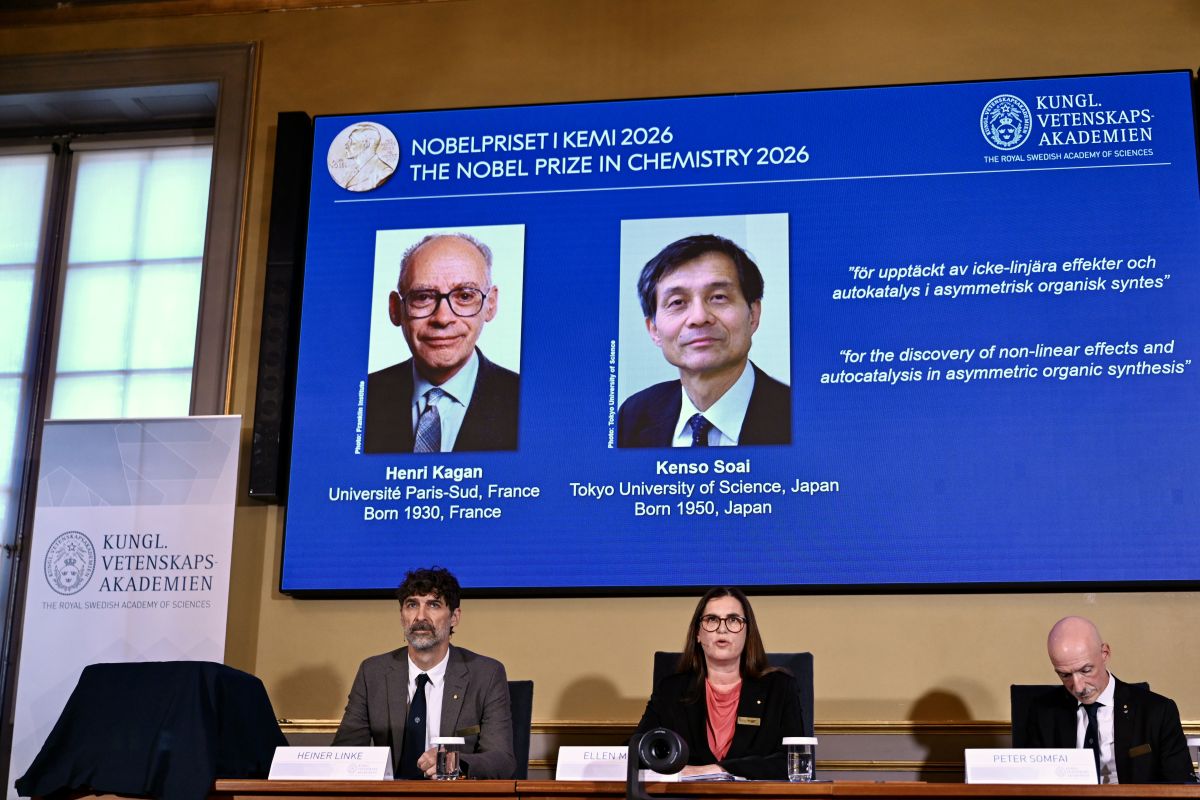
Many molecules behave in much the same way. This seemingly simple characteristic lies at the heart of the 2026 Nobel Prize in Chemistry, awarded on Wednesday (7 October) to French chemist Henri Kagan and Japanese chemist Kenso Soai for their discoveries of nonlinear effects and autocatalysis in asymmetric organic synthesis.
Their work helps answer a question that has puzzled chemists for more than a century: how can a chemical reaction produce only one molecular ‘hand’, as occurs in the chemistry of life?
Why do molecules have ‘left’ and ‘right’ hands?
Some molecules exist in two forms with the same chemical composition but which are mirror images of each other. Chemists call this property chirality, and the two forms are known as enantiomers.
‘What makes chirality important is that life itself is selective about molecular chirality,’ said Zou Xiaodong, a member of the Nobel Committee for Chemistry, according to Xinhua.
Amino acids, the building blocks of proteins, exist in two mirror-image forms, but only one of them is found in the proteins in our cells. Sugars in DNA also favour one form.
Chemists call this ‘homochirality’, which literally means ‘the same chirality’.
The mystery dates back to the 19th century, when French scientist Louis Pasteur discovered that some molecules exist in two mirror-image forms.
But when chemists later tried to make such molecules through ordinary reactions, they generally obtained nearly equal amounts of both forms.
How did Kagan and Soai help solve the mystery?
The challenge was to find a chemical way to make one mirror-image form the dominant product over the other.
Kagan took an important step in 1986. Chemists generally assumed that if a catalyst contained a certain proportion of one molecular ‘hand’, the product would show roughly the same proportion.
He showed that this relationship could be nonlinear. A small imbalance in the catalyst could create a much greater imbalance in the product.
Put simply, chemistry can amplify a slight initial preference.
Soai took the work further. In the 1990s, he developed a reaction in which the product could help make more copies of itself, a process known as autocatalysis.
In one experiment reported in 1995, an initial imbalance of just 2 per cent increased to 87 per cent. In 2003, Soai demonstrated a reaction that could begin without any inherent chiral preference and still end with a product dominated by one mirror-image form.
Thus, a small difference arising by chance can repeatedly amplify itself until one molecular ‘hand’ almost completely takes over.
In short, Kagan showed how a small chiral preference can be amplified, while Soai demonstrated how a slight dominance can reinforce itself through autocatalysis.
The Nobel Committee described Soai’s reaction as one of the most spectacular chemical experiments ever performed.
Why do these discoveries matter?
The discoveries help explain how homochirality may have emerged, but their significance extends well beyond a century-old scientific puzzle.
Chirality is crucial in drug development because the human body itself is chiral. Two mirror-image versions of the same molecule can interact very differently with proteins and other biological targets.
‘Drug molecules need to be suited to the chirality of the human body, just as a left-hand glove does not fit the right hand properly,’ Zou said.
Zou explained that the ability to select one molecular form enables chemists to make medicines more precisely and reduce unwanted side effects.
The same principle is important in the production of flavourings, fragrances, agricultural chemicals and some advanced materials.
Kagan’s discovery of nonlinear effects also gave chemists a new way to understand and optimise asymmetric reactions, while Soai showed how tiny initial differences can be magnified through a self-reinforcing process.
According to the Nobel Committee, Kagan and Soai have made it possible for chemistry to choose one mirror image over the other.
Source: jawawa.id (https://jawawa.id/newsitem/2026-nobel-chemistry-laureates-solve-the-mystery-of-handedness-1791467683)
Originally published by Antara (Indonesian) (https://www.antaranews.com/berita/5777470/peraih-penghargaan-nobel-kimia-2026-pecahkan-misteri-satu-tangan), translated from Indonesian