
2026 Midterm Elections: The Battle for the US Congress and Global Implications
REPUBLIKA.CO.ID, JAKARTA – The midterm elections in the United States in November 2026 may at first glance appear to be a domestic affair, involving the replacement of seats in Congress and the routine dynamics of parties every two years. However, for the world, the Midterm is more than just a question of who controls the House of Representatives and the Senate in Washington. It reflects the direction of American politics while also affecting the stability of the global order that has long relied on the role of that country.
In the upcoming midterm, American citizens will elect all 435 members of the House of Representatives or DPR, about a third of the Senate members, as well as a number of governors and state-level officials, which together will determine the political power map in Washington.
Historically, Midterms often serve as a mechanism for correcting the current administration. The ruling party almost always loses seats in Congress. This pattern reflects the functioning of checks and balances in the American political system, where voters use this momentum to balance power.
However, the 2026 Midterm takes place in a more complex context. Political polarisation is at a high level and has extended to issues of trust in institutions, including the electoral process. The main concern is not only who wins, but whether the results will be considered legitimate by all parties (The Economist, 25 April 2026).
Narratives about electoral fraud and weaknesses in the voting system have circulated widely in recent years. Various studies have found no evidence of systemic fraud on a large scale. But in politics, perception often determines more than facts. When trust in the electoral process weakens, political stability is also eroded.
In this context, the 2026 midterm can be read as a referendum on Donald Trump’s leadership as well as a test of the resilience of American democracy.
Current dissatisfaction with Trump is triggered by several factors. Pressure from the cost of living is still felt by many citizens. Foreign policy, especially regarding Iran, raises concerns about costly and prolonged conflicts. His leadership style is also judged by some voters as too confrontational and deepening polarisation.
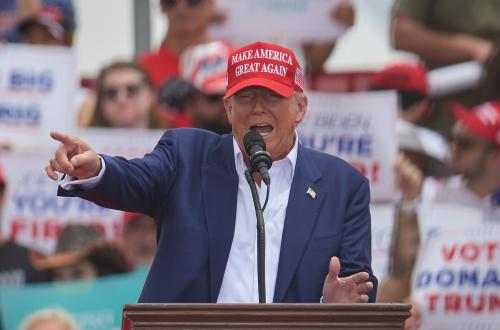
However, support for Trump remains solid among his base, particularly the Make America Great Again or MAGA group. The AP-NORC Center for Public Affairs Research survey in March 2026 shows that Trump still enjoys strong support among Republican voters, while the Reuters/Ipsos survey in April 2026 indicates that issues like immigration still receive widespread support from that base. For this group, Trump is seen as a representation of resistance against political and economic elites in Washington.
In the electoral context, various prediction models are beginning to provide an initial picture. Analysis from The Economist’s April 2026 edition shows that the Democratic Party has a very high chance of regaining the House of Representatives. Historical patterns, relatively low public satisfaction with the government, and increasing competition in several districts are the main factors. For the Senate, the situation is more open because it is highly determined by dynamics in each state.
Nevertheless, the Midterm is still about six months away. Current polling must be read as a temporary snapshot, not the final result. In American politics, six months is a long period. Changes in economic conditions, escalation or de-escalation of foreign conflicts, and the quality of candidates can alter the direction of the contest.
If the Democratic Party controls Congress, the implications will be immediately felt in the governance process. Legislative agendas will be difficult to move, while the oversight function over the executive will increase. Political investigations, budget tug-of-war, and obstacles in appointing officials will become almost certain consequences.
If that scenario occurs, it does not mean Trump’s policies will be completely halted. American political experience shows that the president still has room to manoeuvre through executive authority. Trump could potentially rely on executive orders, tariff policies, and regulatory instruments to continue pushing his agenda without going through Congress. In certain contexts, issues like trade, immigration, and industrial policy could be implemented more unilaterally. At the same time, confrontation with Congress could become part of a political strategy to maintain mobilisation of his support base.
If the Democratic Party controls Congress, the issue of impeaching or impeaching Donald Trump could potentially resurface. Procedurally, the House of Representatives (DPR) has the authority to initiate the impeachment process through a simple majority. However, to remove the president from office, it requires approval from two-thirds of the Senate members, a threshold that is politically very difficult to achieve. With a polarised political composition, impeachment is more likely to become an instrument of political pressure than a realistic path to ending the president’s term.
In such conditions, the direction of American policy, including foreign policy and external economic policy, will increasingly be influenced by domestic dynamics. For global partners and market players, what matters is not only the direction of policy, but the level of certainty and its consistency.
Thus, the 2026 midterm elections are ultimately better read as an indicator of how America will be governed in the next two years. For other countries, the question becomes practical: how predictable is Washington’s policy, and how much room for cooperation remains available.