
2026 EV Subsidy Scheme to Boost National NMC Battery Industry Development
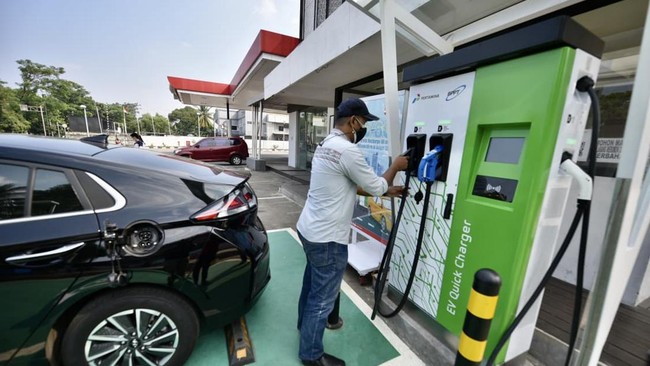
Jakarta, CNBC Indonesia - The government has prepared a nickel-based electric vehicle subsidy scheme set to launch in June 2026, allocating 200,000 units for electric motorcycles and cars. This policy is a crucial instrument to guide the development of the national electric vehicle industry.
Under the proposed scheme, the government will provide a 100% VAT exemption for nickel-based battery electric vehicles or nickel-manganese-cobalt (NMC) vehicles, a 40% VAT exemption for non-nickel-based electric vehicles, and a Rp5 million purchase subsidy per electric motorcycle unit.
The scheme is considered more selective than previous policies. UGM Energy Economics Expert Fahmi Radhi praised the government’s approach of differentiating incentives between nickel-based and non-nickel-based vehicles, including reducing incentives for completely built-up (CBU) imported electric vehicles.
‘Currently, the government is more selective. I believe the incentives for nickel-based vehicles are good because we have nickel production, which can drive downstreaming as part of the national electric vehicle ecosystem,’ Radhi said in a statement on 26 May 2026.
The policy’s relevance is reflected in Indonesia’s rapidly growing electric vehicle market. According to data from the Indonesian Automotive Industry Association (GAIKINDO), total battery electric vehicle (BEV) sales reached 56,204 units in 2024 and surged to 114,413 units in 2025.
However, this growth is still dominated by lithium iron phosphate (LFP) battery vehicles, whose technology and raw materials are not produced domestically. GAIKINDO’s wholesale data shows LFP-based EV sales reached 46,814 units, or 83.3% of the market in 2024, while NMC-based vehicles accounted for 9,390 units, or 16.7%.
In 2025, LFP’s dominance slightly decreased but still controlled 77.2% of the market with 88,344 units. Meanwhile, NMC-based vehicles rose to 26,069 units, or 22.8%.
NMC growth surged 177.6% in 2025, compared to LFP’s 88.7% increase. This indicates Indonesia’s electric vehicle market still has significant room to optimise domestic resources.
At this point, the urgency of nickel-based subsidies is unavoidable. Radhi warned that if the electric vehicle market continues to grow but remains dominated by LFP technology, industrial value addition risks flowing overseas.
‘The most important thing is for Indonesia to seize this opportunity to create an electric vehicle industrial ecosystem from upstream to downstream,’ he said.
Radhi considers NMC-based electric vehicle development strategic because Indonesia holds the world’s largest nickel reserves, which can be directly integrated with the national battery industry. Unlike LFP, NMC technology is more relevant for driving domestic mineral downstreaming and creating value within the country.
According to Radhi, subsidies alone are insufficient. The government must proactively ensure domestic production facilities, increase domestic content levels (TKDN), and secure technology transfers from foreign investors to build an independent electric vehicle industry. He added that consistency in the downstreaming roadmap is crucial for electric vehicle development to deliver national economic impact.
With a large domestic market and strategic mineral resources, Indonesia has strong bargaining power to attract global battery and electric vehicle investments. Radhi also believes MIND ID, the Mining Industry Holding, can play a strategic role in strengthening nickel downstreaming and national battery industry development while partnering with foreign investors possessing NMC battery technology.
He stated that consistent nickel-based subsidy policies will be key to ensuring the electric vehicle market does not merely become a destination for imported products but becomes the foundation for national battery industry self-sufficiency.