
2026 Economic Census to Serve as Foundation for National Development Planning
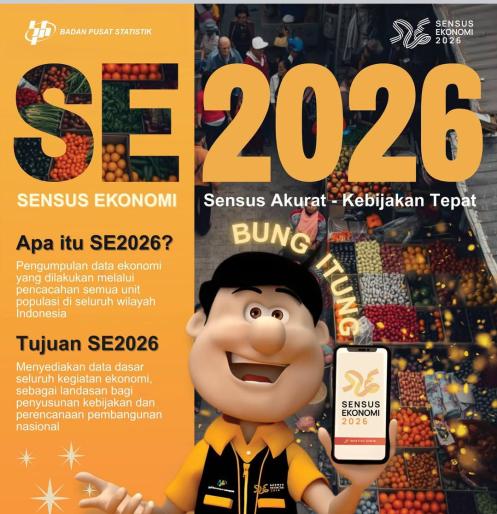
The government, through the Central Statistics Agency (BPS), has officially commenced the 2026 Economic Census (SE2026), which will run from May to August 2026 across all regions of Indonesia. This nationwide initiative is a strategic agenda to obtain a comprehensive overview of the national economic condition, including the development of the business sector in Kabupaten Seluma. The Economic Census is a comprehensive data collection effort on various economic activities carried out by business actors, ranging from micro, small, and medium enterprises to large-scale corporations. The data collected will serve as a crucial reference for the government in formulating more effective and measurable economic policies that align with the needs of the community. BPS has emphasised that the success of the 2026 Economic Census heavily relies on the support of the entire community. Therefore, business actors and residents are expected to welcome the census officers tasked with conducting direct data collection in the field. During the data collection process, the public is requested to provide information honestly, completely, and in accordance with actual conditions. All submitted data will be kept confidential in accordance with statutory regulations and will be used solely for statistical purposes. The data gathered through the 2026 Economic Census will serve as the foundation for the government in designing various economic development programmes. This includes formulating policies for micro-enterprise empowerment, enhancing the competitiveness of business actors, creating employment opportunities, and developing strategies for equitable development across different regions. For Kabupaten Seluma, the census results are expected to provide a more accurate picture of the region’s economic potential. This information will assist the local government in identifying leading sectors, developing investment opportunities, and strengthening coaching programmes for MSMEs to enable them to grow more competitively. Furthermore, valid economic data is a crucial factor in attracting investors. With comprehensive information on business conditions, the number of economic actors, and the potential of productive sectors, the government can formulate more targeted investment strategies to create sustainable economic growth. The results of the Economic Census also offer benefits to the business community. The statistical data produced can serve as a reference for identifying market opportunities, understanding the development of economic sectors, and forming the basis for more effective business strategies. BPS invites all members of the public to actively participate in ensuring the success of the 2026 Economic Census. Public participation is the key to ensuring that the resulting data truly reflects the real condition of the Indonesian economy. Census officers visiting homes and business premises will be equipped with official identification so that the public can easily recognise them. Their presence is expected to be well received so that the data collection process can proceed smoothly, safely, and on schedule. Through cooperation between the government, business actors, and the community, the 2026 Economic Census is expected to produce high-quality statistical data. This data will serve as the basis for formulating various development policies aimed at improving public welfare, strengthening regional competitiveness, and accelerating national economic growth. The government urges all residents of Kabupaten Seluma not to hesitate in providing accurate information when census officers conduct data collection. Accurate data is not merely a statistical figure, but also a crucial foundation for realising more equitable development, improving the quality of public services, strengthening the MSME sector, opening new investment opportunities, and delivering better welfare for all Indonesians in the future.