
2026 Economic Census: An Investment in Knowledge to Navigate National Development
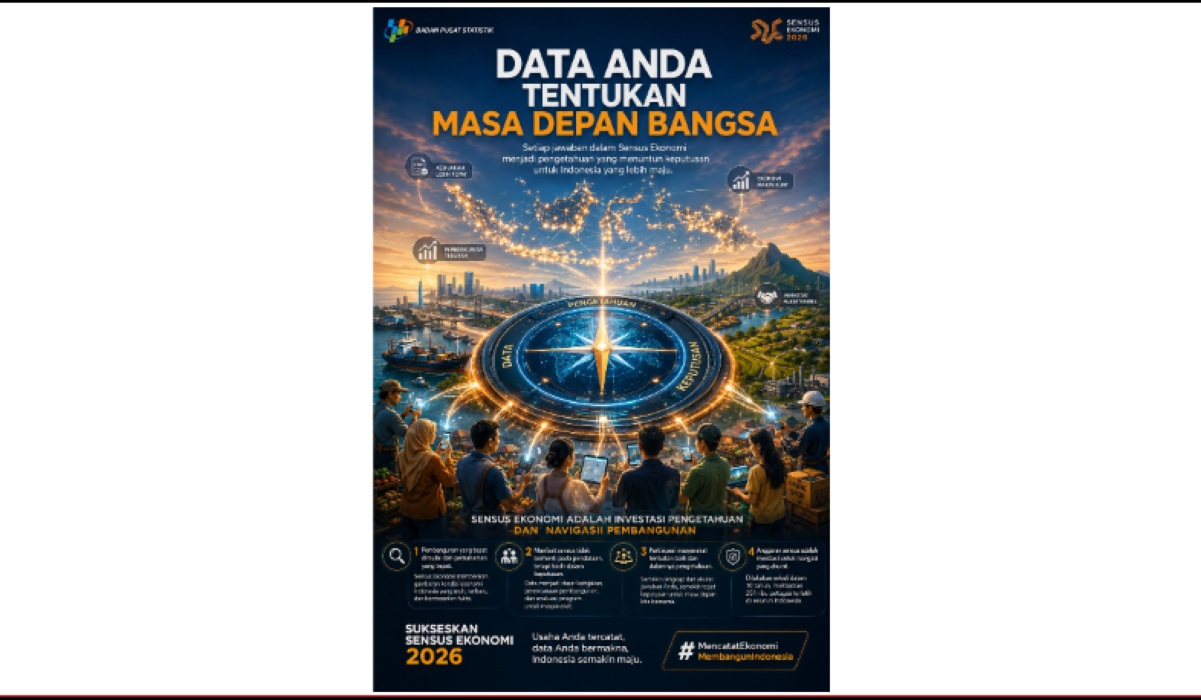
Every day, the government makes various strategic decisions that directly impact the public economy. These decisions encompass the formulation of MSME development programmes, infrastructure construction, market expansion, capital creation, investment promotion, and the evaluation of ongoing policies. To ensure every policy is precisely targeted, the government requires a profound understanding of actual economic conditions.
The 2_026 Economic Census plays a vital role as it is tasked with collecting data from business actors and households across all corners of Indonesia. The resulting data is not merely numbers, but knowledge that provides a complete and up-to-date picture of the national economic condition.
Knowledge derived from this census serves as a navigation tool for development. Much like a Global Positioning System (GPS) that determines a travel route, the results of the Economic Census help the government map regions where economic activities are expanding, sectors that require special attention, and community groups that must be prioritised. With this data, decisions are no longer made based on estimates, but on the actual conditions on the ground.
The benefits of the Economic Census do not end when the data collection process is complete. Its greatest value emerges when that data is implemented as a basis for decision-making. The better the understanding of the data, the more accurate the reading of market and community needs becomes.
Conducting an Economic Census in Indonesia presents a significant challenge. As an archipelagic nation with vast territory and diverse geographical conditions, reaching millions of business actors in remote areas requires extra effort. To ensure the success of the 2026 Economic Census, approximately 251,000 officers are being involved. These officers have undergone standardised training from Sabang to Merauke.
The success of this major agenda depends heavily on public participation. Correct, complete, and honest responses from respondents will produce accurate data. This data accuracy enriches knowledge and clarifies the navigational direction of national development.
Given the national scale and the substantial budget required, the Economic Census is conducted once every ten years, typically in mid-year. The Central Statistics Agency (BPS) has been preparing for the implementation of the 2026 Economic Census since 2024, a thorough preparation process spanning more than two years.
The budget allocated for the Economic Census is essentially an investment in knowledge. Its value is measured not only by the operational costs during data collection but by the long-term benefits when the data is used as a decision-making guide by various parties.
Through accurate data, the community can experience the impact of higher quality and more equitable economic development. Unlike previous economic censuses, the 2026 census will not only record business actors but also households.
As the way people conduct business continues to evolve, from traditional market stalls to marketplaces, the BPS continues to strengthen synergy with local governments to ensure the success of the 2026 Economic Census (SE2026).