
200,000 People in Red Fill Amsterdam, Demand Sanctions against Israel
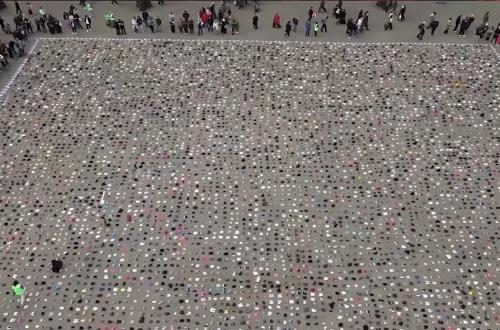
JAKARTA — A wave of solidarity with Palestine has once again shaken the Netherlands. More than 200,000 people, most wearing red, filled the streets of Amsterdam on Sunday (8 November 2026), calling on the government to take stronger action against Israel over its military attacks and the ongoing humanitarian crisis in the Gaza Strip. The large demonstration also showed that public pressure has not eased, despite the Dutch government having imposed several trade restrictions on Israel.
The action, known as Red Line, centred on demands to end economic and military ties that demonstrators say help support Israeli operations in Palestinian territories. They urged the government to impose broader trade sanctions, halt arms purchases and exports, and formally declare Israel’s actions in Gaza to be genocide.
Amnesty International Netherlands, one of the organisers, said more than 200,000 people took part. This was the organisers’ estimate, calculated in part using crowd-monitoring tools and aerial footage. No independent police count confirming the exact number of participants was available.
Al Jazeera reported on Sunday (8 November 2026) that thousands of demonstrators wore red and carried Palestinian flags and protest banners. Calls for Palestine’s liberation rang out along streets temporarily closed to traffic. Museumplein, one of Amsterdam’s best-known public spaces, served as the gathering point before the crowd moved around Vondelpark.
The colour red was chosen as a symbol of a boundary that organisers say Israel has crossed through its military operations in Gaza and its occupation of Palestinian territories. The movement’s central message was “No Money for Genocide”. Through the slogan, participants called for an end to economic ties they believe support Israeli policies and military activities.
One demonstrator, Mike van Dongen, said the conditions faced by people in Gaza were unacceptable from a humanitarian perspective. Speaking to the Associated Press, he criticised the Dutch government’s response, which he said had not exerted meaningful pressure on Israel. In his view, the government remained reluctant to take sufficiently firm action to stop the violence.
The demonstration also drew people from a range of backgrounds, including participants with family ties to Israel. Steven Eisinger, a 33-year-old American robotics engineer, said he was Jewish and had family in Israel. However, he said he supported the Palestinian people and opposed Israel’s military actions in Gaza.
“Stop sending weapons to Israel,” Eisinger told AFP, according to Middle Eastern media outlets Arab News and Ahram Online on Sunday.
Fourth demonstration, public pressure remains
The Amsterdam action was the fourth Red Line demonstration organised by a Dutch civil-society coalition since 2025. The movement had previously mobilised large crowds in The Hague and Amsterdam. Organisers have used repeated demonstrations to keep public attention on Gaza and Dutch government policy.
According to Amnesty International, around 100,000 people took part in the first demonstration, in The Hague in May 2025. The second, in June 2025, was estimated to have drawn 150,000 participants, while more than 250,000 attended the third, in Amsterdam in October that year, according to organisers. The large turnouts show that Palestine has become a significant issue in the Dutch civil-society movement.
The fourth demonstration involved a coalition of 13 organisations, including Amnesty International, Oxfam Novib, Save the Children and several human rights groups. These organisations say the restrictions already imposed by the government are not enough to end economic ties that could support the occupation of Palestinian territories.
According to Dutch public broadcaster NOS, demonstrators also carried banners criticising support for Israeli apartheid and occupation. Several senior political figures attended, including former Amsterdam mayor Job Cohen and former foreign minister Jozias van Aartsen. Their presence showed that calls for greater pressure on Israel also have support among former government officials.
The event in Museumplein included speeches by activists, community figures and Palestinian representatives. Speakers announced by the organisers included Palestinian journalist Amal Helles, former Dutch minister Lilianne Ploumen and boycott-movement activist Omar Barghouti. The organisers used the forum to reiterate calls for the government to increase political, economic and diplomatic pressure on Israel.
The Red Line movement is also demanding that the Dutch government stop buying Israeli weapons. In addition, organisers have called for a review of investment and trade ties with companies involved in Israeli settlement activity in occupied Palestinian territories. They argue that Dutch foreign policy should comply with the country’s obligations to protect human rights and uphold international law.
Israel and the Netherlands embroiled in diplomatic dispute
The demonstration took place amid rising diplomatic tensions between the Netherlands and Israel. In September 2026, the Dutch government began enforcing a ban on trade in products originating from Israeli settlements in occupied territories. The policy covers products from settlements in the West Bank, East Jerusalem and the Golan Heights.
According to Anadolu Agency on 27 September 2026, the ban, which took effect on 22 September, covers not only imports but also the purchase and sale of certain products linked to Israeli settlements. The Dutch government said the policy was intended to prevent involvement in economic activity that sustains an occupation it considers contrary to international law.
Israel then retaliated. Israeli Foreign Minister Gideon Sa’ar announced the withdrawal of the diplomatic status granted by Israel to Dutch diplomats serving in Ramallah, in the West Bank. The diplomats were given seven days to return the diplomatic documents issued by Israel.
According to Anadolu, Sa’ar said the decision was a response to Dutch government policies that he considered harmful to Israel’s interests. He also said his government would not allow unilateral actions against Israel to go unanswered. The move further strained relations between the two countries, which had already been at odds over policy on Gaza.
The Dutch government expressed regret over Israel’s decision. Foreign Minister Tom Berendsen said the ban on settlement products was not intended to punish the Israeli public as a whole, but was related to the Netherlands’ obligation to respect international law. The Dutch government also summoned Israel’s ambassador to seek an explanation about the impact of the withdrawal of diplomatic status.
Diplomatic tensions had already risen in August 2026, when Israel expelled two Dutch representatives from the international coordination centre for Gaza in Kiryat Gat. The Israeli government linked the move to a series of Dutch policies it considered hostile to Israel, including plans to restrict trade in settlement products.
The dispute shows that trade and diplomatic policy towards Israel has become a significant issue in relations between the two countries. The Dutch government is seeking to increase pressure through measures it considers consistent with international law, while Israel views those policies as discriminatory and unfriendly.
Source: jawawa.id (https://jawawa.id/newsitem/200-000-people-in-red-fill-amsterdam-demand-sanctions-against-israel-1794189076)
Originally published by Republika (https://news.republika.co.id/berita/to7lv7451/200-ribu-massa-berbaju-merah-penuhi-amsterdam-desak-sanksi-terhadap-israel), translated from Indonesian