
20 Years of Google Translate: Its Translation Scale Equivalent to 12,000 Years of Reading
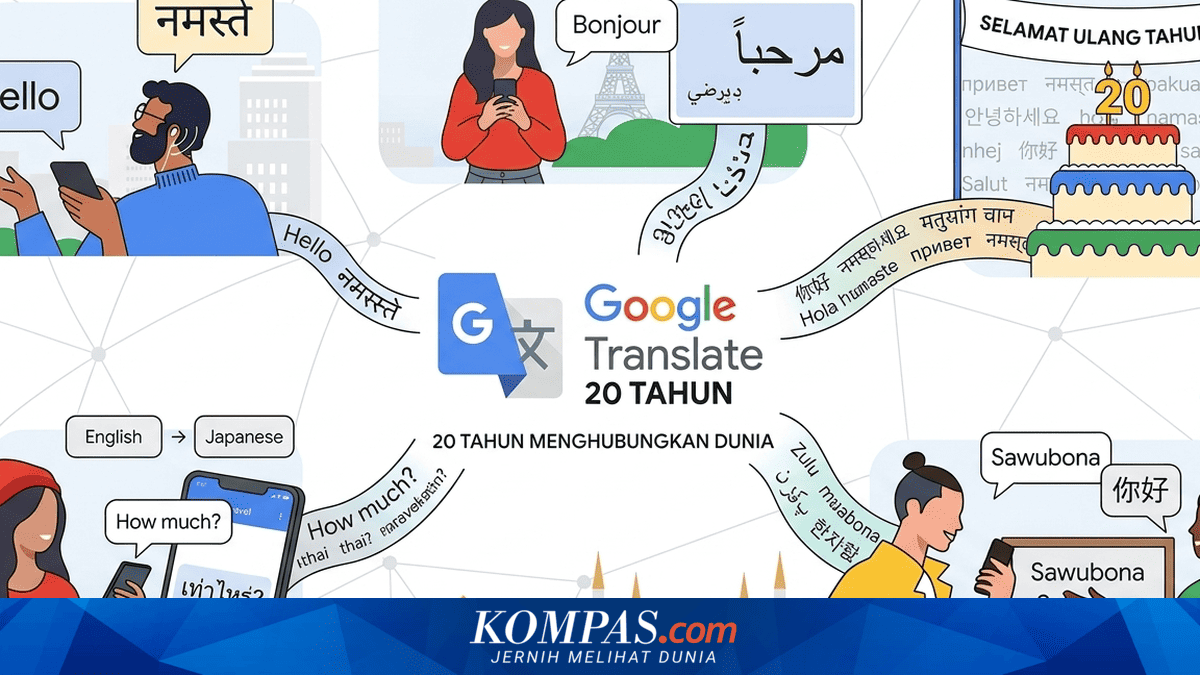
Google’s translation service, Google Translate, officially enters its 20th year in April 2026. From a small experiment on 28 April 2006, Google Translate has transformed into an essential tool used by billions of people to understand the world across languages. In celebration of its 20th anniversary, Google shares several interesting facts about how the service has developed and is used globally. One of the most attention-grabbing is the current scale of its usage. To illustrate the scale, Rose Yao states that the amount of text is enough to be read non-stop for 12,000 years. Google Translate now also supports nearly 250 languages and covers about 95% of the world’s population, including regional languages and endangered ones. The technological journey behind the service is quite long. At its initial launch, Google Translate used a statistical approach to translate word by word. However, since 2016, Google has switched to neural network technology, making translation results more natural and contextual. Now, with support from the latest AI models like Gemini, Translate not only translates text but also understands context, idioms, and even slang. Interestingly, behind all that advanced technology, the most frequently searched translation content turns out to be simple. Google states that the most translated phrases over the years are not technical or business terms, but everyday sentences like “thank you”, “hello”, “how are you”, “please”, and “I love you”. One of them is the “Pronunciation” feature. This feature complements the language learning feature named “Practice” which was previously introduced in 2025. Through the Practice feature, users can learn languages via real conversation simulations. There is a “Listen” option to train listening skills, as well as “Roleplay” for two-way dialogue practice. Now, Google adds the “Pronunciation” feature to help users train pronunciation. Its operation is quite simple. After translating a sentence and selecting the Practice button, users will see the “Pronounce” option next to “Listen”. When this feature is selected, Google Translate will display the phonetic spelling of that sentence, then activate the microphone. Users can immediately say the sentence, and the system will provide an assessment and feedback, for example, if the pronunciation is unclear. For now, the Pronunciation feature is only available on the Android app, and is still limited to some countries like the United States and India, as well as for English, Spanish, and Hindi.
Source: jawawa.id (https://jawawa.id/newsitem/20-years-of-google-translate-its-translation-scale-equivalent-to-12-000-years-of-reading-1777686725)
Originally published by Kompas (https://tekno.kompas.com/read/2026/05/02/08030077/20-tahun-google-translate-skala-terjemahannya-setara-12.000-tahun-bacaan?utm_source=ABC&utm_medium=rss), translated from Indonesian