
20 Educators Receive Awards for Learning Innovations
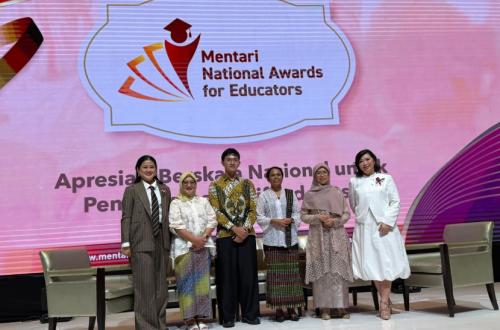
Twenty educators from various regions have received the Mentari National Awards for Educators (MNAE) 2026 in recognition of the learning innovations developed within their respective schools. These innovations range from project-based learning and the utilisation of artificial intelligence (AI) to literacy programmes that connect student work with environmental activities.
The awards, organised by the Mentari Group, saw participation from 770 applicants representing 228 cities/regencies and 679 schools. Twenty educators were selected as award recipients across three categories: ten Mentari Changemaker Awards, five Mentari Leadership Awards, and five Mentari Educator Awards.
One such innovation was developed by Mahendra Surya from SMP Nation Star Academy Surabaya, featuring project-based science learning. Students were engaged in studying plastic pollution while creating bioplastic prototypes from biodegradable materials. Through this project, students studied the impacts of pollution and material characteristics, evaluating texture, flexibility, durability, and the potential for bioplastic degradation.
“As a science teacher, I believe that science learning should not only focus on memorising concepts. Students need to experience meaningful science learning and apply scientific knowledge to solve real-world problems,” said Mahendra.
Another innovation was developed by Desi Susanti from SMA Negeri 1 Sendawar, West Kutai, East Kalimantan. Through her ‘Science Detective’ programme, Desi transformed physics learning into an investigative activity using a Soundcard Oscilloscope and AI chatbots. The implementation of this method reportedly resulted in a 100 per cent material mastery rate. Desi also shares her teaching practices through over 76 videos on her YouTube channel, @ibudesifisika, as well as through various training sessions and teacher communities.
“Good practices should not stop in a single classroom. Therefore, I attempt to share these experiences through digital platforms, training, and teacher communities so they can be studied and developed by other educators,” said Desi.
Meanwhile, Meildy Louisa Kese from Sekolah Lentera Harapan Labuan Bajo, East Nusa Tenggara, developed the School Book Writing Movement (GSMB). This programme, which has grown into an annual activity, involves students in book writing, literacy festivals, cover design competitions, and exhibitions. Proceeds from the sale of student books are used to support environmental activities, including the planting of more than 200 bamboo seedlings.
“Literacy is not just about the ability to write, but about how students can use their ideas to achieve an impact. Therefore, our programme continues to be developed so that students’ literary works and abilities can be connected to real action,” said Meildy.
Andri Nurcahyani, Head of the Primary and Secondary Education Working Group of the National Accreditation Agency for Primary and Secondary Education (BAN-PDM) for the 2023–2026 period, noted that the teaching practices developed by these educators should be shared to serve as references for other schools. “These practices are important to recognise and appreciate because they demonstrate the genuine efforts of educators to improve the quality of learning and school management,” said Andri.
Natalina Rimba, Executive Director of Mentari Group, expressed hope that the award recipients would continue to develop innovations and share their experiences with other educators. “We hope this award serves as appreciation for your contributions to advancing Indonesian education, while also encouraging the continued development and sharing of innovations to provide broader benefits for education,” Natalina stated on Tuesday (29/9/2026).
MNAE 2026 is also aligned with support for the fourth Sustainable Development Goal (SDG) regarding quality education, particularly through the development of learning practices and the strengthening of the educator’s role.