
2.95 Million Free Health Check Participants Have Eye Disorders, Putting Indonesia’s Productivity at Risk
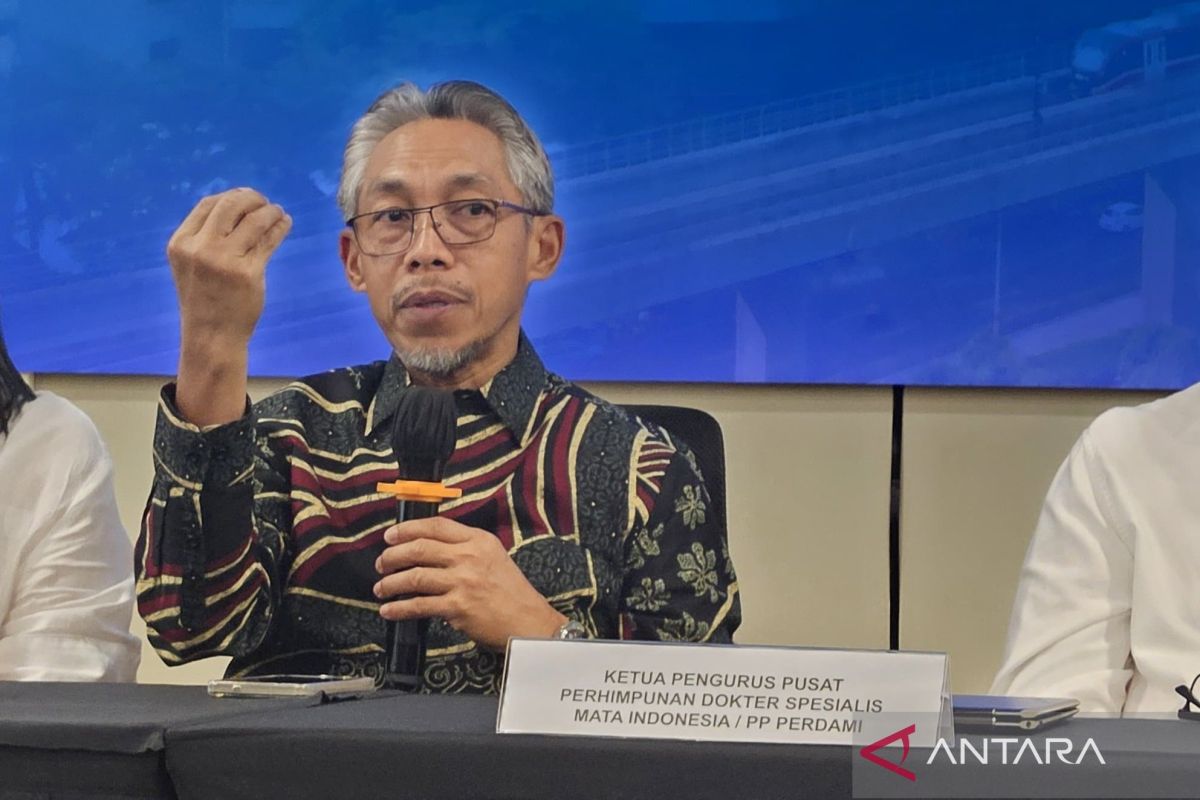
Jakarta (ANTARA) – The Indonesian Ophthalmologists Association (PERDAMI) said around 2.95 million of the 23.35 million people who took part in the Free Health Check programme (CKG) in 2025–2026, or nearly 10 per cent, had eye disorders, which could affect Indonesia’s productivity.
PERDAMI central board chair Budu said in Jakarta on Tuesday that many of those people were unaware they had vision problems and postponed follow-up care until it was too late or they had become permanently blind.
“Among people aged over 50, the prevalence of blindness is 3.0 per cent, and 81.2 per cent of cases are caused by cataracts,” Budu said.
He also cited a Health Ministry survey indicating that 600,000–650,000 cases of blindness are caused by cataracts. The Government is therefore seeking to strengthen nationwide screening to prevent this.
Eye health, he said, is not only about vision; it can also affect the economy and social life.
“The International Agency for the Prevention of Blindness estimates that we will lose US$411 million – that is, billions – in productivity. Calculated per day, the loss would be US$1.1 billion,” he said.
“Third, the future of our children is at stake. With vision problems, their chances of pursuing education are five times lower than those of children with good vision,” he said.
Budu said Health Minister Budi Gunadi Sadikin wanted to increase Indonesia’s life expectancy. Achieving this would require readiness to tackle blindness, including providing older people with access to cataract surgery.
“The main causes of blindness and vision impairment are, in fact, very easy to treat and prevent at an early stage,” Budu said.
Globally, he said, 510 million people have uncorrected near-vision impairment and 161 million have uncorrected distance-vision impairment. A further 100 million people have cataracts that have not been operated on.
PERDAMI also highlighted other causes, including macular degeneration (8.1 million cases), glaucoma (7.8 million) and diabetic retinopathy (4.4 million).
Acting Director-General for Disease Control at the Health Ministry Andi Saguni said eye care must not end with screening, but should be integrated so that patients can receive follow-up care appropriate to their needs and the provider’s expertise.
“Investment in eye health is, in fact, an investment in the quality of Indonesia’s human resources,” he said.
Andi urged people not to wait until they experienced eye problems, but to recognise signs of vision impairment, undergo regular screening and examinations, and seek prompt follow-up if a problem is found.