
172 Priority Crossings to Close in First Half of 2026, KAI Strengthens Safety Education for Students
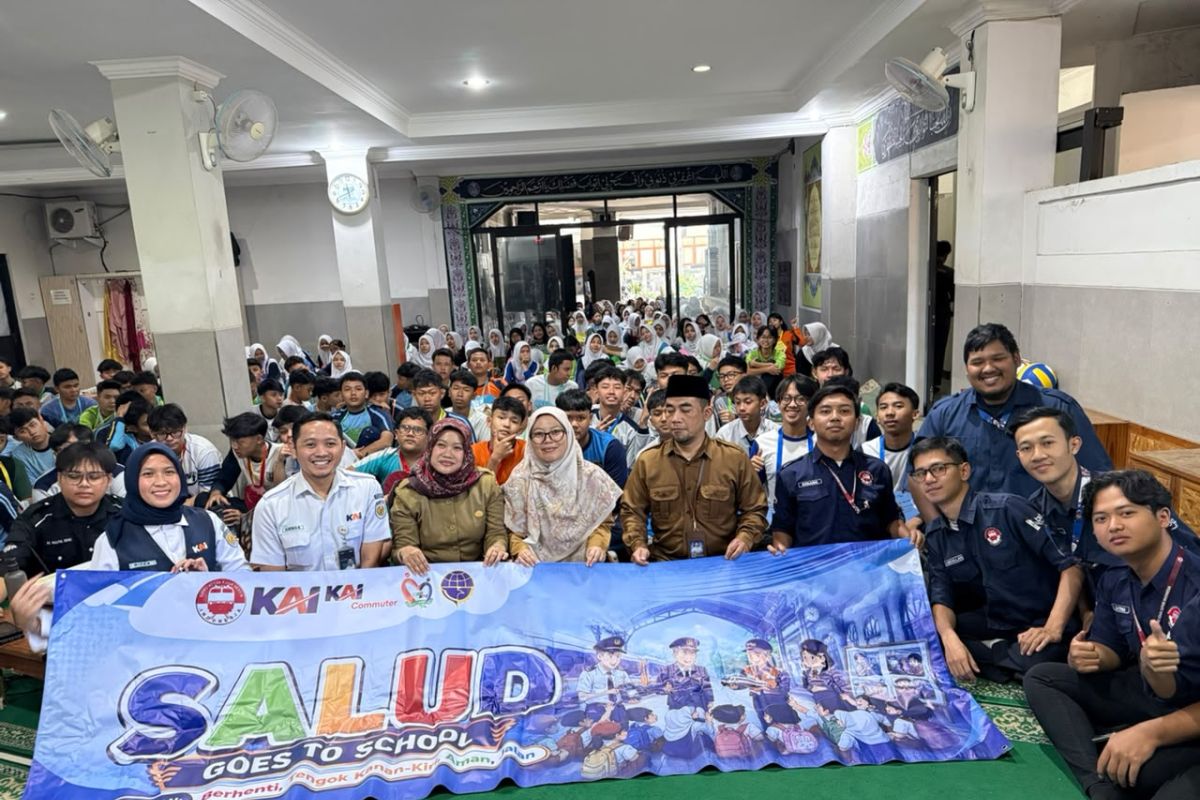
The momentum of the new school year coincides with a United Nations high-level meeting on road safety on 20–21 July 2026. Railway travel safety requires compliance from all road users, including the younger generation who are active in public spaces daily. This understanding was reinforced by PT Kereta Api Indonesia (Persero) through railway safety socialisation for students at SMAN 6 Bandung on Monday (20/7).
The activity, themed ‘Smart, Safe and Sustainable: Becoming a Young Generation that Cares about Railway Safety’, focused on introducing the characteristics of trains, risks around the tracks, the obligations of road users at level crossings, and the steps to take when a train is about to pass.
Vice President Corporate Communication of KAI, Anne Purba, stated that students play a vital role in expanding the safety culture because the knowledge they receive at school can be applied and shared with their families and surrounding environment. ‘Safety can start from simple habits, such as staying away from railway tracks, not trespassing at crossings, stopping when warning signals are active, and reminding each other when seeing risky behaviour,’ said Anne.
One of the main materials explained why trains cannot stop suddenly. A single passenger train set in Indonesia generally consists of 8 to 12 carriages weighing around 600 tonnes, not including passengers and luggage. This length and weight mean the train requires a much longer braking distance compared to road vehicles. The distance is influenced by speed, brake type, track gradient, weather conditions, braking force magnitude, train set type, and other technical conditions.
In a simulation presented to the students, a train travelling at 60 kilometres per hour requires a braking distance of approximately 221 metres. At 80 kilometres per hour, the distance reaches around 379 metres. When a train travels at 100 kilometres per hour, the braking distance can reach approximately 505 metres, and at 120 kilometres per hour, it can reach around 860 metres. These figures may differ according to operational and technical conditions.
‘The long braking distance explains why road users must stop before the railway track. When a vehicle or person is already on the tracks, the train driver has very limited room to avoid the risk,’ Anne said. Students also received an explanation about the dangers of emergency braking. The braking system on a train set operates using air pressure. A sudden release of pressure can cause uneven braking and increase the risk of the rolling stock derailing, dragging, or overturning.
These characteristics confirm that safety at level crossings cannot depend on the train’s ability to stop. Road users must ensure they are in a safe position before the train passes. The socialisation material summarised five main steps for students: do not play near the tracks, do not trespass at crossings, stop when the signal sounds, give priority to train travel, and ensure personal and others’ safety.
The use of mobile phones and audio devices should also be avoided when approaching crossings. Such activities can reduce a road user’s ability to see and hear warning signs or the sound of an approaching train. The obligation to give priority to train travel is stipulated in Article 124 of Law Number 23 of 2007 concerning Railways. This provision states that road users must give priority to train travel at level crossings between railway tracks and roads.
Similar provisions are regulated in Article 114 of Law Number 22 of 2009 concerning Road Traffic and Transportation. Vehicle drivers are required to stop when signals sound, crossing gates begin to close, or there are other signs that a train is about to pass. Violations of this provision may be subject to sanctions under Article 296 of Law Number 22 of 2009, in the form of imprisonment for a maximum of three months or a fine in accordance with statutory regulations.
‘Crossing gates, sirens, warning lights, signs, and officers are devices to warn road users. The decision to stop and wait remains the responsibility of every person at the crossing,’ Anne explained. Students were then invited to use a simple principle before crossing the tracks: stop, look left and right, ensure it is safe, then proceed. This principle should still be applied even if the crossing is equipped with gates and officers.
According to Anne, safety education needs to be delivered repeatedly because risks around the tracks often arise from habits considered trivial, such as playing on the tracks, taking photos too close to the line, using headsets, or rushing to cross. ‘Railway tracks are not a place to play, walk, gather, or create content. The track is a train operation space that must always be sterile for safe travel,’ Anne said.
In addition to safety, students received a brief introduction to sustainable transportation, service technology, customer protection in public spaces, and career opportunities in the railway sector. All this material was positioned as enrichment so that the younger generation understands that the railway system requires discipline, technology, and competent human resources. KAI hopes that socialisation in schools can help shape a generation that understands risks, obeys rules, and dares to remind others when they find dangerous behaviour around railway tracks.
Source: jawawa.id (https://jawawa.id/newsitem/172-priority-crossings-to-close-in-first-half-of-2026-kai-strengthens-safety-education-for-students-1784541423)
Originally published by Antara (Indonesian) (https://www.antaranews.com/berita/5657061/172-perlintasan-prioritas-ditutup-pada-semester-i-2026-kai-perkuat-edukasi-keselamatan-bagi-pelajar), translated from Indonesian