
15 Illegal Buildings on Juanda Street Demolished for Green Space
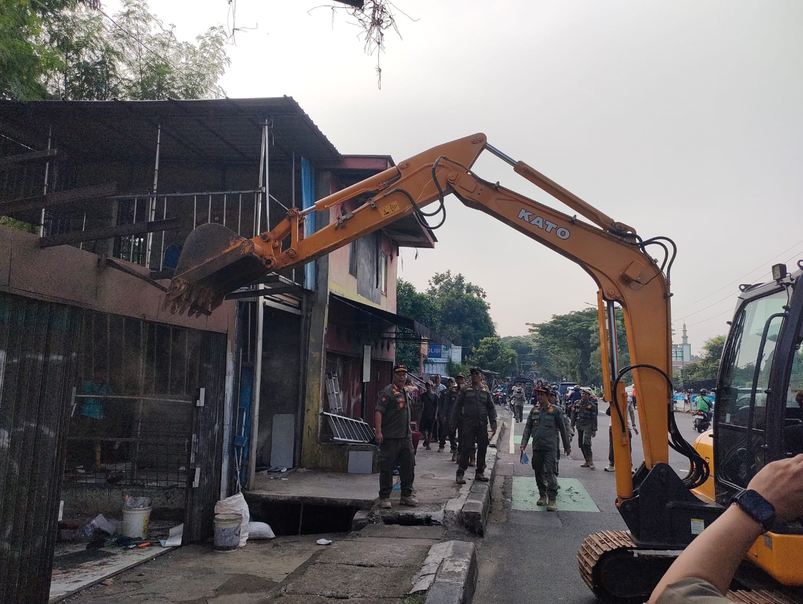
The Depok Public Order Agency (Satpol PP), together with Indonesian National Armed Forces (TNI) and National Police (Polri) personnel, demolished 15 illegal buildings along Jalan Insinyur Haji Juanda, Baktijaya Urban Village, Sukmajaya District, on Friday (26/6). The enforcement action was carried out to uphold spatial planning regulations, restore the function of public facilities, and address flooding caused by the narrowing of waterways.
Head of the Peace, Public Order, and Escort Security Division (Kabid Trantibum Pamwal) of the Depok Satpol PP, Agus Muhammad, stated that the permanent and semi-permanent structures cleared had previously been used as residences and business premises.
According to Agus, the demolition process proceeded smoothly without any resistance from the building owners. He noted that this was due to the persuasive approach undertaken by the Satpol PP prior to the enforcement.
“The enforcement and demolition of the buildings were preceded by intensive dialogue and the provision of sufficient notice periods, with the aim that owners could evacuate their belongings or carry out independent demolition to avoid greater material losses,” Agus said.
He explained that before the demolition, the Satpol PP had issued three warning letters and opened a dialogue with the building owners. Agus added that the involvement of TNI and Polri personnel in the operation was part of the standard procedure for enforcing Regional Regulations (Perda) to ensure the process was safe and to anticipate potential security disturbances.
“We synergise with the TNI-Polri. This synergy is standard procedure in the enforcement of Regional Regulations (Perda),” he stated.
According to Agus, one of the main reasons for the enforcement was that the illegal buildings stood over drainage channels, narrowing the water flow capacity and increasing the risk of flooding during heavy rain. He explained that the covered waterways were also filled with sediment and household waste, preventing optimal water flow.
“The accumulation of household waste, sediment, and the narrowing of the water channels cause water to overflow onto road surfaces and residential areas,” Agus explained.
Beyond narrowing the drainage, the presence of these buildings also reduced water catchment areas, leaving the channels unable to accommodate water volume during high rainfall. Following the demolition, the cleared land was immediately handed over to the Depok Environmental and Sanitation Agency (DLHK) for redevelopment.
The Depok City Government plans to convert the area into green open space (RTH), parks, and reorganised drainage areas as an effort to reduce flood risk while improving environmental quality.