
147.55 Million People Travel During the 2026 Lebaran Transport Period
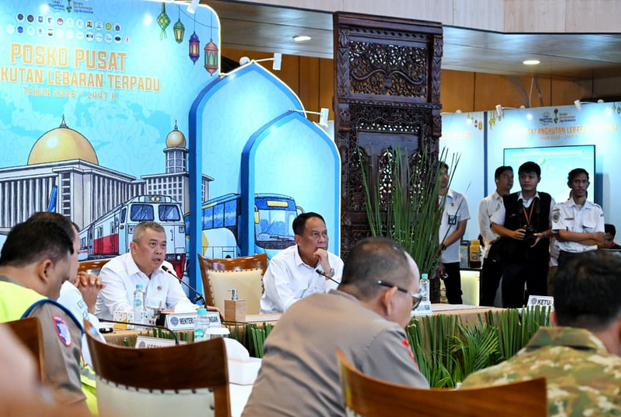
Transport Minister Dudy Purwagandhi stated that the number of people travelling during the Lebaran Transport period (13-29 March 2026) reached 147.55 million people. This figure is up 2.53% from the previous survey estimate of 143.92 million people.
For public transport passengers, the Minister of Transportation noted a 10.87% increase during this year’s Lebaran Transport period compared to the previous year, from 21.23 million passengers to 23.51 million passengers.
Breaking down by mode of transport, road transport recorded 3.89 million passengers, up 11.64% from 3.49 million in 2025. Sea transport had 2.02 million passengers, up 9.86% from 1.84 million in 2025.
Air transport saw 4.77 million passengers, up 6.97% from 4.47 million in 2025; rail transport had 7.31 million passengers, up 10.13% from 6.64 million in 2025; and ferry transport recorded 5.52 million passengers, up 15.36% from 4.79 million in 2025.
On the safety front, data from the Indonesian National Police indicates that the number of traffic accidents during the 2026 Lebaran Transport period was 3,517 incidents. This represents a 6.31% decrease compared to the previous year, which had 3,754 incidents.
Accident fatalities also declined by 31.19% compared to the previous year. The number of deaths from accidents was 300 people, compared to 436 during the 2025 Lebaran Transport period.
“This achievement is something we should be grateful for, but it must also serve as material for evaluation for future improvements. I want to reiterate that safety remains the top priority in every transportation operation. There should be no compromise on the airworthiness of facilities, readiness of infrastructure, or compliance with operational standards,” said Dudy in his statement on Monday (30/3).
The Minister of Transportation continues to push for strengthened safety measures, including ramp checks, field supervision, and integrated traffic control. Likewise, the utilisation of technology and information systems to enhance responses to on-site dynamics.
On the other hand, he said, the quality of service to the public must also be continuously improved. “Transportation must be an effort to move people and goods while providing a sense of safety, comfort, and certainty to the public,” he concluded.