
14-Point US-Iran MoU: Tehran Scores Big, Trump Saves Face
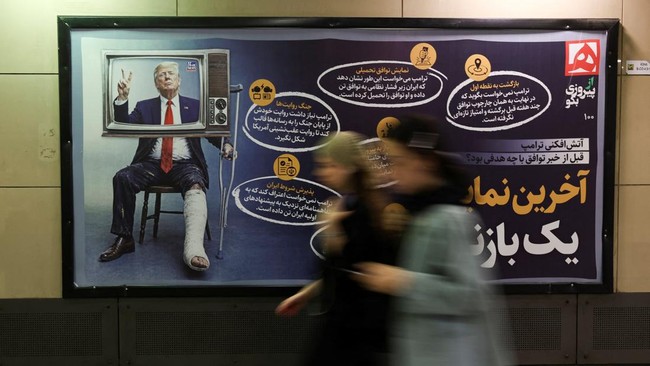
The 14-point MoU between the United States and Iran, scheduled to be signed in Bürgenstock, Switzerland, on 19 June 2026, will likely be touted by Washington as a major success for the US and President Trump. That is not entirely wrong. The war stops, the Strait of Hormuz is reopened, energy markets can calm down, and Iran returns to international oversight.
However, when read more deeply from US government sources explaining the MoU’s contents, this agreement is not a strategic victory for the United States. It is more of a politically viable exit for Washington. The US can save face, mitigate global economic risk, and reduce domestic political pressure, especially regarding the Republican Party’s chances in this November’s legislative elections. But the party that gained the greater advantage is Iran.
Iran did not get everything it wanted. But Tehran obtained the most decisive things: the regime remains secure, the war stops without Iran having to surrender, its economic access begins to reopen, its position over Hormuz remains strategic leverage, and its civilian nuclear programme is not completely dismantled.
In negotiations like this, victory does not always mean getting all demands met. The agreement was born because the cost of war became too high for both sides and the world. For the US, continuing the war meant risks to oil prices, inflation, energy supply chain disruptions, and increasingly difficult-to-control domestic political pressure. The Iran-US war could no longer be treated as merely a regional conflict. Its impact had already entered global markets.
Washington needed a success narrative to exit the war without appearing to retreat. Hormuz had to be reopened. Iran’s nuclear programme had to be placed back under supervision. Global energy risk had to be lowered. With that package, the US could tell its domestic public and allies that military and diplomatic pressure had succeeded.
Iran also needed certainty. But its needs were different. Tehran was not looking for an exit that made it appear defeated. Iran needed a cessation of war without losing its main strategic cards: the regime remains solid, civilian nuclear capacity is not dismantled, and its position over Hormuz is not lost.
At this point, the MoU becomes an asymmetric compromise. The US obtains a cessation of war. Iran maintains its bargaining position.
Broadly, the MoU’s contents can be read in five groups. First, cessation of hostilities on all fronts. Second, reopening of the Strait of Hormuz. Third, easing of sanctions, opening of oil exports, and release of some Iranian assets. Fourth, Iran’s commitment not to pursue nuclear weapons, with IAEA oversight. Fifth, continued negotiations over 60 days towards a final agreement.
What is important is not only what is written. What is unwritten is even more decisive. There is no total dismantling of Iran’s nuclear programme. No missile disarmament. No regime change agenda. No provisions forcing Iran to hand over all its strategic cards.
That is where Iran’s victory lies.
First, the war stops without the Iranian regime collapsing. This is a very significant political victory. If the goal of war pressure was to make Iran surrender or trigger an internal crisis shaking the regime, that goal was not achieved. Tehran remains a negotiating party, not a party forced to surrender.
Second, sanctions begin to be eased. This is not just an economic matter. Easing sanctions means acknowledging that maximum pressure cannot be maintained indefinitely. Once oil exports are reopened and some Iranian assets are released, US leverage will diminish. The longer this process runs, the higher the political cost for Washington to return to maximum pressure.
Third, Hormuz remains an Iranian bargaining chip. It is true that Hormuz is reopened. But that reopening does not mean Iran loses strategic control. Rather, this MoU acknowledges the reality that Hormuz’s stability cannot be separated from calculations involving Iran. Without Iran, Hormuz cannot be guaranteed stable. That is a very strong message.
Fourth, Iran’s nuclear programme is not completely dismantled. Iran accepts oversight and commits not to pursue nuclear weapons. But what is retained remains significant: civilian nuclear capacity. For Tehran, this is not merely a technology programme. It is a symbol of sovereignty, national capability, and strategic bargaining position.
The US certainly does not return empty-handed. Washington can claim that the war was successfully stopped, Hormuz was reopened, the risk of energy crisis was reduced, and Iran returned to the path of international oversight. For US domestic interests, that claim is important.
However, a distinction must still be made between saving face and winning. The US did not succeed in forcing Iran to completely dismantle its nuclear programme. The US did not succeed in pushing for the disarmament of Iran’s strategic capabilities. The US also did not succeed in dismantling Iran’s regional influence. What the US obtained was stabilisation. That is important, but it is not a maximal victory.
On the other hand, Israel becomes the party that most clearly lost momentum. For Israel, the ideal outcome of the war was certainly not just a cessation of hostilities. Israel wanted Iran permanently weakened, its nuclear programme eliminated, Tehran’s regional influence reduced, and if possible, Iran’s power structure shaken as well.
This MoU produces the opposite. Iran is not crippled. Its nuclear programme is not eliminated. Its regional influence is not broken. The US chose stabilisation, not escalation. This means Israel’s maximal agenda did not form the basis of the final agreement.
Iran’s opposition is also in a difficult position. They hoped war pressure would weaken the regime’s legitimacy, deepen the internal crisis, and open new political space. But this MoU instead gives the regime a political lifeline.