
13 Years of IMIP and the Story of Downstreaming in Bahodopi
The map at the sub-district office in Bahodopi has not been updated since 2009. On that slightly faded canvas, the area still appears as mere grasslands and trees. A few small village points are marked with circles, connected by dashed lines representing roads. There is no indication of an industrial zone, no symbols for ports, airports, or smelters.
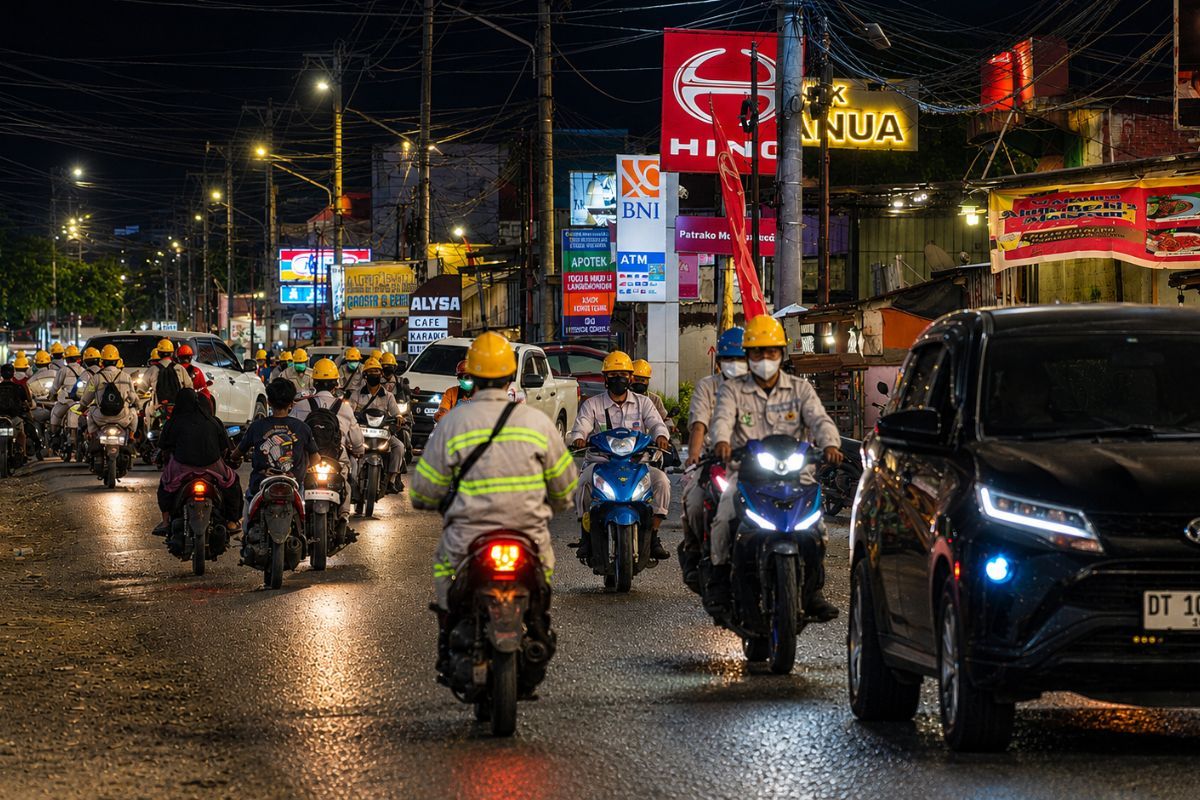
From the same office window, however, the view has far outpaced its map. Smelting plants stand almost parallel in the distance, accompanied by the continuous roar of factory machinery that never truly stops, day or night. The roads that were merely dashed lines on the map are now smoothly paved, traversed by material transport trucks and motorcycles of workers changing shifts. The sub-district officials, pointing from the map to the window, know well that the document on their office wall is now a historical record rather than a contemporary depiction.
Thirteen years ago, the gap between the map and reality did not exist. PT Indonesia Morowali Industrial Park (IMIP) had just been established, as one of many projects born from the national nickel downstreaming policy. It was a major gamble that Indonesia would no longer merely export raw ore, but would instead process it domestically, from the mine to the finished product. Bahodopi, a small sub-district whose name was rarely heard before, became one of the points where that gamble was proven.
The massive steps taken by IMIP carried a grand vision: not only to build a robust mineral downstreaming industry for the nation but also to ensure that economic vitality flows heavily to the local community and businesses surrounding the area. For IMIP, the number 1lar 13 is not just a marker of time, but a symbol of the resilient synergy between upstream-downstream industries and the independent entrepreneurs growing alongside them.
Within this area, there are three clusters driving Bahodopi. The first is the stainless steel cluster, which focuses on processing nickel ore into NPI and final stainless steel products such as slabs, HRC, and CRC. This cluster is one of the largest production bases for nickel and stainless steel in a single area. The second is the carbon steel cluster, built to produce carbon steel to meet national and global construction and tool requirements. The third is the battery raw material component cluster, which processes supporting materials for the electric vehicle ecosystem, including cathode and anode elements for lithium-ion batteries.
In addition to these three main clusters, the IMIP area is supported by auxiliary industries such as coal-fired and solar power plants, supporting chemical plants (silicon, manganese, lime, coke), as well as specialised port and airport facilities.
Today, IMIP is no longer just an industrial project; it has transformed the landscape of Bahodopi and revitalised the surrounding economy.
Data from the PT IMIP HR Department records massive growth in the workforce within the IMIP area. In 2020, the number of workers was 35,592; in 2021, it rose to 51,542. By 2022, there were 68,466; in 2023, 74,350; and in 2024, approximately 83,000. By 2025, it increased to 86,804, and as of September 2026, the number of employees in the area has reached 100,310, consisting of 91,904 male employees and 8,406 female employees.
With such a large total worker population, the circulation of money is undoubtedly significant. For instance, in 2025 alone, with a worker population of 86,804, the estimated monthly money circulation in Bahodopi is expected to reach Rp499.1 billion, or the equivalent of Rp5.9 trillion per year. Such a figure is not merely a statistical nominal; it creates daily needs that the industrial zone cannot meet alone.
“The massive growth of the area has also driven the development of the business sector in Bahodopi. Research notes the five most common types of MSMEs in Bahodopi include Pertamini kiosks (981 units), beverage stands (735), non-building food stands (670), general kiosks (648), and eateries (591). Most MSMEs fall into the micro-enterprise category with annual turnovers of up to Rp300 million, but the growth trend shows potential for upgrading,” said Dedy Kurniawan, Head of the Media Department at PT IMIP, on Friday (02/09/2026).
The impact of this has elevated Central Sulawesi Province, making it stand out above Riau Islands and most other provinces. The Head of the Bank Indonesia Representative Office for Central Sulawesi, Muhamad Irfan Sukarna, in the Central Sulawesi Provincial Financial Report (February 2026), stated that the economy of Central Sulawesi grew by 9.43% (yoy) in the fourth quarter of 2025, an increase from the 7.79% (yoy) in the previous quarter. “The economic growth performance of Central Sulawesi is supported by the dominant role of nickel-based processing industries, mining, and quarrying within the regional economic structure,” wrote Muhamad Irfan Sukarna in his report.
Since the beginning, IMIP has realised that building an integrated nickel ecosystem—from ore processing and smelters to the energy supply chain—would be incomplete without socio-economic inclusion. Over the past thirteen years, the IMIP area has dedicated itself to being a strategic partner for businesses around the industrial zone, opening its doors wide to local contractors, logistics providers, artisans, and hundreds of culinary and housing MSMEs that support the lives of tens of thousands of workers in the area.
Source: jawawa.id (https://jawawa.id/newsitem/13-years-of-imip-and-the-story-of-downstreaming-in-bahodopi-1791039335)
Originally published by Antara (Indonesian) (https://www.antaranews.com/berita/5770146/13-tahun-imip-dan-cerita-hilirisasi-di-bahodopi), translated from Indonesian