
13 Shallow Earthquakes Shake Bandung, BMKG Reveals Surprising Facts
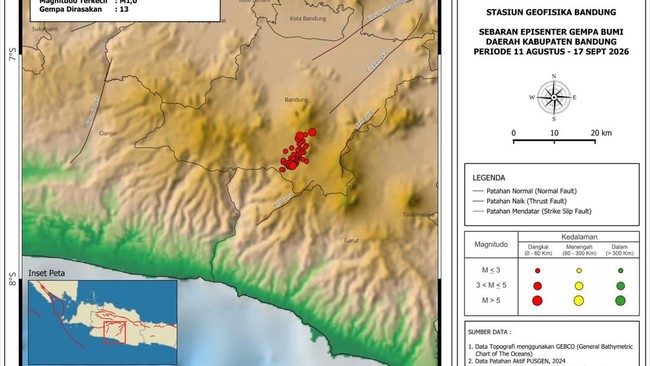
A total of 13 earthquake events have shaken the Bandung Regency area from 11 August to 17 September 2026, at 08:00 WIB. The Meteorology, Climatology, and Geophysics Agency (BMKG) recorded magnitudes varying between M1.0 and M3.4.
According to the Director of Earthquakes and Tsunamis at BMKG, Wijayanto, the tremors were felt in Pangalengan, Talegong, Cisewu, and surrounding areas with an intensity of II-III MMI. This means vibrations were noticeably felt inside houses, resembling the sensation of a heavy truck passing by.
“Considering the location of the epicentres, the earthquakes that occurred are classified as shallow earthquakes,” Wijayanto stated in his briefing on Thursday (17/9/2026).
“BMKG’s analysis shows that the earthquake epicentres form a linear pattern towards the Southwest-Northeast, approximately 5-8 km west of the Garsela Fault Kendang Segment and north of the Garsela Fault Kencana Segment. Tectonically, these earthquakes are related to local fault activity,” he added.
Epicentres Located in Unmapped Areas
Wijayanto referred to the 2024 Indonesia Earthquake Source and Hazard Map published by the National Earthquake Study Centre (PuSGen), noting that the distribution of these earthquakes does not fall within the Garsela Fault Kendang Segment, Garsela Fault Kencana Segment, or the Cicalengka Fault zones.
“Instead, they are located in an area that has not yet been mapped. In this regard, a more in-depth study regarding these earthquake sources is required,” he said.
Currently, he added, BMKG operates 36 seismic sensors distributed throughout the West Java region. “The presence of these dozens of seismograph networks plays a very crucial role as they are capable of detecting and recording micro-earthquakes or small-magnitude tremors with a fairly good level of precision,” he noted.
“Such small-scale seismic activity generally originates from the movement of active faults on land-based faults stretching across the West Java region,” he explained.
Wijayanto stated that BMKG will continue to monitor earthquake activity and provide updated information to stakeholders and the public. “An appeal to the public: remain calm and do not be influenced by unverified issues,” he emphasised.
“Ensure that official information is sourced only from BMKG, disseminated through verified official communication channels (Instagram/Twitter @infoBMKG @BMKGBandung),” concluded Wijayanto.