
12 Updates on Iran-US War: Trump Loses-Regime Change for Mojtaba Khamenei
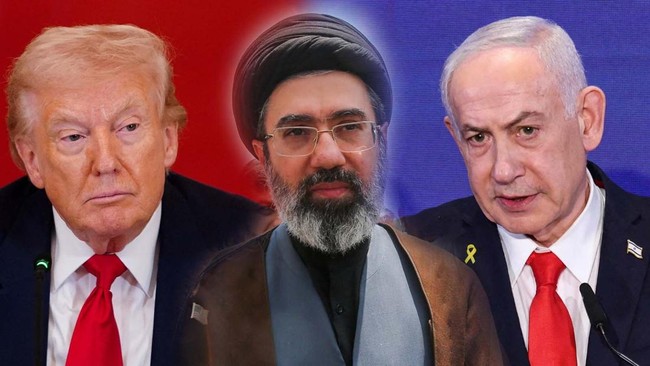
The war between the United States (US) and Israel with Iran has entered a new phase after US President Donald Trump claimed he will reach an agreement with the Iranian government to end the three-week conflict. According to him, the talks are going very well, although Iran has denied this.
What are the updates? Here is a summary from CNBC Indonesia, Tuesday (24/3/2026).
- Trump Loses
The surprising statement about negotiation efforts and halting US attacks on Iran has brought relief to Gulf countries. Previously, Trump had threatened to target Iran’s electricity infrastructure on Tuesday night if the Strait of Hormuz was not opened.
So, has Trump lost?
According to observers, this is Trump’s attempt to concede first. This is because his action of bombing Iran’s electricity could provoke a stronger retaliatory strike from Tehran.
“Trump is conceding first – because of the clear understanding that attacking Iran’s energy infrastructure will trigger direct and significant retaliation,” wrote Danny Citrinowicz, a security analyst and former Israeli intelligence expert on Iran, on X.
- Trump Phones Netanyahu
Trump has held talks with Israeli Prime Minister Benjamin Netanyahu after announcing a temporary “ceasefire” with Iran. He promised that Israel’s interests in the Middle East will also be protected in the negotiations of the agreement that has been established with Iran.
“President Trump believes there is an opportunity to leverage the extraordinary achievements of the Israeli and US militaries to achieve the war’s objectives in an agreement, an agreement that will safeguard our vital interests,” said Netanyahu in a video after speaking with Trump, as reported by AFP.
- Israel Pounds Beirut
Nevertheless, Israel has not finished pounding areas considered part of Iran’s military proxies. In Beirut, for example, Israel struck its southern suburbs several hours after its military issued evacuation warnings to local residents.
- Pakistan PM Phones Iranian President
Pakistan PM Shehbaz Sharif said he had spoken with Iranian President Masoud Pezeshkian regarding the “serious situation in the Gulf region”. He affirmed Pakistan’s commitment to playing a “constructive role in promoting peace”.
- Israel’s Defence System “Breached”
Damage to Israel’s “David’s Sling” air attack interception system. The system was breached, allowing two Iranian ballistic missiles to hit the southern part of the country, injuring dozens over the weekend.
The system is a key component of Israel’s layered air defence shield, also commonly known as Iron Dome.
- Israel Attacks Basij Battalion of Iran’s Revolutionary Guard
The Israeli military announced that they attacked a location in Tehran owned by Iran’s Revolutionary Guard and used to direct the paramilitary Basij battalion. The strike occurred a few days after Israel announced it had “eliminated” the head of Basij intelligence in an attack that also killed the top commander of those forces, Gholamreza Soleimani.
Israel is targeting Basij forces as part of efforts to weaken Iran’s control over power. The number of casualties from this attack is not yet known.
- UK Summons Iranian Ambassador in London
The UK Foreign Office summoned Iran’s ambassador to London, Seyed Ali Mousavi. The Kingdom criticised what it called “reckless and destabilising actions” by Tehran in the UK and abroad.
“This summons follows charges against two individuals, one Iranian national and one British-Iranian dual national, under the National Security Act, for allegedly providing assistance to a foreign intelligence service,” said a Foreign Office spokesperson.
- Devastating Effects of War
The International Committee of the Red Cross has called for an end to the “war on critical infrastructure” in the Middle East and warned of the possibility of “irreversible consequences”. Including damage to nuclear facilities.
“What we are witnessing in the Middle East in recent days risks reaching a point of no return,” warned ICRC President Mirjana Spoljaric in a statement.
- UK Sends Air Defence to Gulf
The UK is sending short-range air defence systems to the Middle East to counter Iranian missile attacks. This was stated by PM Keir Starmer.
“We are rapidly deploying short-range air defence systems to Bahrain,” Starmer told a parliamentary committee, adding that the UK is “doing the same with Kuwait and Saudi Arabia”.
- “Terrorism” in Strait of Hormuz
The head of UAE state-owned energy company ADNOC condemned Tehran’s blockade of the Strait of Hormuz, which has caused a surge in oil prices. He called Iran’s actions “economic terrorism against every country”.
“No country should be allowed to hold Hormuz hostage,” said Sultan Ahmed Al Jaber in a virtual statement at the annual CERAWeek conference in Houston.
- Trump Mentions ‘Regime Change’ for Mojtaba Khamenei
Trump announced “very good” talks with an unnamed Iranian official. This came after he suddenly postponed plans to attack power plants in the Islamic republic.
Trump emphasised that the talks, which were denied by Tehran, were not with Iran’s new supreme leader Mojtaba Khamenei. Rather, with a party he called “very rational” and said that so many high-ranking officials have died in the conflict that “regime change has automatically occurred”.
- Oil Disruption ‘Temporary’
US Energy Minister Chris Wright said that oil market disruptions are “temporary”, amid surging costs due to the war in the Middle East.