
12.4 Million Hectares of Critical Land to Be Restored with Bamboo
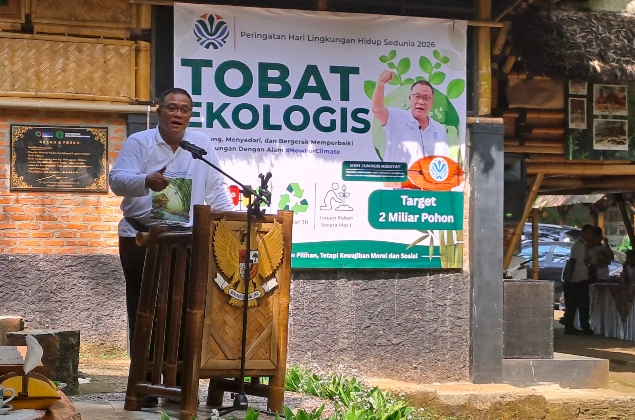
Environment Minister Moh. Jumhur Hidayat has identified bamboo planting as a solution for environmental rehabilitation, adding that the measure can also serve as an additional source of income for communities through carbon trading schemes. He made the remarks during a discussion titled ‘The Movement to Plant Bamboo Saves the Earth, A Clump of Bamboo for a Million Benefits’ organised by the Indonesian Bamboo Foundation and the launch of the 2026 Nusantara Bamboo Planting Movement in Cibinong, Bogor, on Sunday (14/6). The discussion was attended by central and regional government officials, academics, environmental communities, conservation activists, and the public.
According to Jumhur, the carbon trading mechanism can operate when emissions from industrial activities exceed permitted limits. The excess must then be compensated through the planting of carbon-absorbing vegetation, such as bamboo. ‘When an industrialisation process occurs, it inevitably produces emissions. Those emissions have limits. If they exceed what is permitted, they must be offset by specific planting so that the emitted carbon can be reabsorbed,’ Jumhur said.
He explained that greening projects like bamboo planting hold economic value because the plant’s capacity to absorb carbon dioxide can be calculated using specific methodologies. Once calculated and verified, the government will issue emission certificates that can be traded on the carbon market. Through this scheme, Jumhur is optimistic that communities can secure two sources of income simultaneously. ‘The trees are safe, and the community earns an income. So there are two revenue streams, from the bamboo cultivation itself and from the carbon value resulting from emission reductions,’ he clarified.
Beyond providing financial benefits, this greening-based carbon trading is also considered capable of opening new environmentally friendly job opportunities at the community level. The government is currently encouraging active public participation so that people can earn more income while preserving nature. Jumhur also emphasised the significant potential of bamboo as a conservation plant and as part of Indonesia’s local wisdom, noting that bamboo is highly effective for restoring critical land areas and watersheds. ‘We have around 12.4 million hectares of critical land. I want to launch a massive movement to plant bamboo everywhere. Nationally, the number could reach millions, perhaps even hundreds of millions of bamboo planted,’ he stated. Concluding his remarks, Jumhur challenged environmental communities and bamboo activists to begin preparing massive nurseries to ensure the success of the national movement.