
11 Kilometres Across Bogor: The Palace, History and Surken
Jakarta (ANTARA) – Five thousand rupiah for a glass of green grass jelly and a little ice. A passing street vendor provided a pleasant pause on my wife’s and my walk through Bogor on Saturday, 17 October 2026. I lifted the glass, breathed in the aroma of the green grass jelly, took a slow sip and uttered the name of the Creator. A happy smile, the pleasure of the taste, and gratitude. I looked behind me: a blue sign pointed towards the Botanical Gardens and Baranangsiang Terminal. Our walk still had an enticing destination ahead: Surken and its food.
That day, the record on my smartwatch showed 16,000 steps and an estimated 540 calories burned. That probably meant a distance of about 11 kilometres. What is certain is that we stopped often along the way. Something would catch our attention, slow our pace, prompt us to take out our phone cameras and pause to look. That is the pleasure of trekking. I may have travelled the same roads in Bogor hundreds of times before. The difference was that I used to be in a vehicle, with neither the time nor the reason to pay attention to everything along the way.
At 7.27am, we took our first steps from in front of Bogor Station. Green angkot minibuses passed, motorbikes lined the road, and vendors set up along the kerb. That morning, Bogor showed its everyday face, with people already on the move to attend to their business.
In Amsterdam, the Rijksmuseum holds a photograph of the station’s predecessor, dated to around 1880–1888. It is titled Stationsgebouw te Buitenzorg—the station building in Buitenzorg. It is fascinating to imagine how many people have emerged from the station into the same city, wearing different clothes, travelling in different vehicles and pursuing different interests. Today, we had come to explore the city on foot.
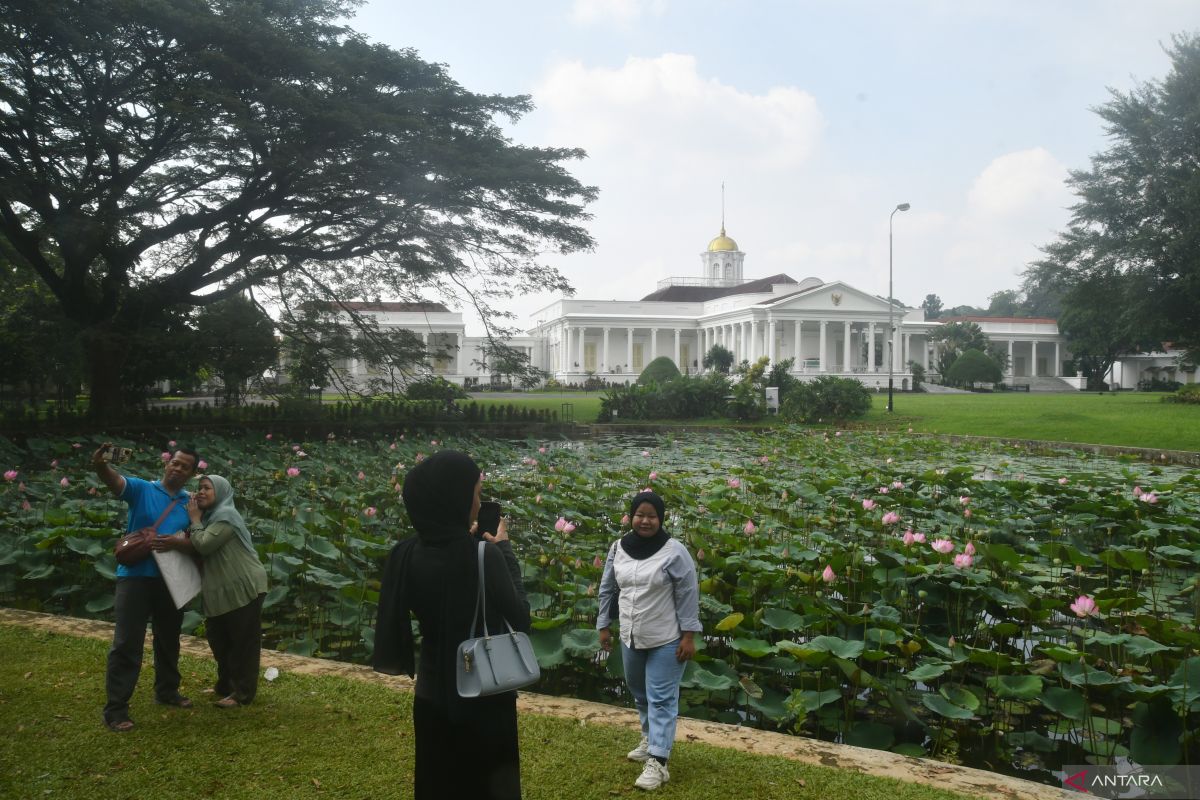
From the station, we walked along the road, passed the city hall and then crossed towards the Bogor Palace area. The white pillars and veranda of the government building hold a long history. According to records from the heritage conservation agency, it was built in 1868 as a societeit, a social club with restricted membership. In 1971, the building became a municipal government office.
Imagining how its occupants have changed gives the building a different quality. People once came as members of a club; now government business takes place inside. We continued on. Across the road, the palace fence enclosed expanses of grass and trees, opening up a view that was more spacious than the rows of buildings behind us.
The deer were the next sight to stop us. Some were grazing, others sheltering in the shade. Visitors watched them through gaps in the fence from the pavement. The spotted deer, or Axis axis, is native to the India–Nepal region and has lived on the palace grounds since the early 19th century. A November 2020 publication by the State Secretariat put their number at more than 800.
Clearly, the view has long attracted people. A lithograph published in 1842 and held by the Rijksmuseum depicts a herd of deer in front of the palace. The work was issued through a network spanning Amsterdam, Paris and London. I captured the scene on my smartphone, then paused at a spot where the palace grounds could be seen more clearly.
The palace began with Gustaaf Willem Baron van Imhoff’s desire for a place to rest outside Batavia. He chose the site in 1744 and began building a country retreat in 1745. It was named Buitenzorg, meaning roughly ‘without worries’. He drew the initial sketches himself, taking inspiration from Blenheim Palace in England.
The building we see today has undergone alterations and reconstruction, including after the 1834 earthquake. A painting of the disaster is also held in the Netherlands. It shows people fleeing, the palace damaged and deer trying to escape. The painter, Willem Troost, had never been to Indonesia; he may have worked from someone else’s sketches.
That history gave me another image of the palace grounds. A place that now seems peaceful was once the scene of panic. After independence, the Republic used the building for presidential activities. Soekarno once lived in the complex; decades later, Jokowi and his family moved into the Dyah Bayurini Pavilion in May 2015.
The palace complex occupies about 28.86 hectares, with buildings covering around 14,892 square metres. Those figures help convey the scale of the grounds we were viewing from outside the fence. Behind the trees and lawns, official work and receptions for state guests remain part of the palace’s role.
We continued our walk around the Bogor Botanical Gardens, completing more than one circuit before heading to Sempur Field. Trees along the route repeatedly caught my attention. I really liked them. One had a huge trunk and long hanging roots that formed a curtain. Some roots had thickened and joined together, as if the tree were adding supports for its own body.
It was difficult to fit the whole of such a large tree into the camera frame, so I photographed it from below. At another point, a tall bamboo grove drew my gaze upwards again. The stems stood close together, with light filtering between them. Identifying the species would require a closer examination; for now, I chose simply to enjoy the view in front of me.
The Botanical Gardens, established in 1817, were once known as the Lands Plantentuin, the government botanical garden. Plants from various regions were collected and studied there. The Leiden University Library preserves accounts by travellers who admired its avenues of banyan trees. In the late 19th century, the gardens also drew European scientists to work there.
The small discovery that intrigued me most was a flower growing on a tree trunk. At first, I thought an orchid was growing on it. The flower was reddish pink and attractive to look at close up. It turned out that its features closely matched those of the cannonball tree, Couroupita guianensis, which is native to tropical South America.
The flower grows from a stalk that emerges directly from the tree’s trunk. The term for this is cauliflory. The name ‘cannonball’ refers to the tree’s round, hard-shelled fruit, which resembles a cannonball. I enjoy surprises like this: walking lets us see things that are easy to miss when travelling in a vehicle. My mistaken guess that it was an orchid led to a new discovery.
Sempur Field brought us into a different atmosphere. Green grass stretched out, a blue track looped around it, and the word SEMPUR provided a backdrop for a photograph of the two of us. The track is reported to be about 323 metres per lap. Three laps are almost a kilometre. For anyone wanting to walk regularly without leaving the area, that makes the distance easy to calculate.
Sempur is also connected with the expansion of Buitenzorg, planned by Thomas Karsten from 1917. His garden-city concept linked residential areas with green spaces. At the time, the planning took place within an unequal colonial society. Today, the field is a shared public space, where people come to exercise, bring their families or simply enjoy time outdoors.
As our walk continued, that glass of green grass jelly felt like the perfect stop. When grass-jelly leaves are crushed with water and strained, they can form a gel. IPB University research has shown that certain types of gel can even form using cold water. Curiosity leads to questions, and questions to knowledge. It all began with a simple drink sold by a middle-aged vendor walking around the city.
Then we arrived in Suryakencana. A red gate with a Chinese-style roof greeted us. The Lawang Suryakencana gate was officially opened in February 2016. The area beyond it is much older. During the colonial period, the street was known as Handelstraat, or Trade Street, where commerce and the family lives of trading communities developed around the market.
Colonial rules also concentrated Chinese residents in designated areas. Hok Tek Bio Temple, now known as Dhanagun Vihara, served as a place of worship and social activity for the community. I still do not know when it was founded. In this neighbourhood, Chinese heritage meets local life, carried on by people who have traded, worshipped and raised families there for generations.
I noticed old houses with louvred windows, ventilation openings, pillars and ornamental trim. Then, through the lanes that cut across the street, the mountains caught my eye again. In the middle of the shops, there was a chance to look out over Bogor’s landscape. The mountains around the city form a backdrop that appears at times and is hidden at others by buildings and the weather. We kept walking, taking in our surroundings.
The next temptation was a local dish: toge goreng. It consists of bean sprouts and noodles topped with a thick sauce and sweet soy sauce. Absolutely delicious. The name may make people think it is fried, but the bean sprouts are actually boiled. Ah, fooled! Tauco and oncom are also part of the mixture. After tens of thousands of steps, our attention had turned to the food on the table.
Cungkring completed our culinary hunt that day. In Surken, a walking plan can easily grow into a food plan. Here, the pleasure of looking at old buildings and watching the bustle of vendors goes hand in hand with the pleasures of the palate. We arrived curious and found that Bogor always offers a reason to stop—and to pause along the way.
The area’s transformation into a culinary destination happened gradually. Vendors’ accounts point to more noticeable growth from the 2000s, although some food businesses had been there much earlier. In 2020, the city government opened Teras Surken to organise some of the vendors. People once came to the street to buy household necessities; now they also come because they are hungry.
In the end, 16,000 steps brought home more stories than I had expected. There were deer that had appeared in images almost two centuries ago, a flower I mistook for an orchid, and five-thousand-rupiah grass jelly from a travelling vendor. Bogor felt closer after we explored it on foot. The rest, let our taste buds remember Surken. My wife and I agreed: this is a walk worth repeating.
Source: jawawa.id (https://jawawa.id/newsitem/11-kilometres-across-bogor-the-palace-history-and-surken-1792659150)
Originally published by Antara (Indonesian) (https://www.antaranews.com/berita/5804309/bogor-11-km-istana-sejarah-sampai-surken), translated from Indonesian