
11 Dramas of JCI's Decline Throughout This Year, Investors Spooked
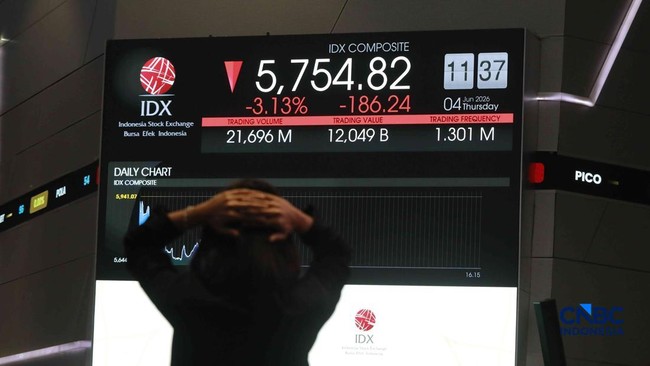
The movement of the Jakarta Composite Index (JCI) from the beginning of the year to early June has recorded dynamics of considerably high volatility. Various sentiments, both domestic and global, have alternately exerted pressure and provided a boost to the performance of the Indonesian capital market. This volatility has been clearly recorded in a series of important events that served as turning points for the index’s direction, ranging from regulatory policies and international rating issues to foreign capital flows and geopolitical tensions that triggered macroeconomic uncertainty among investors. Below is a comprehensive breakdown of various crucial events that specifically influenced the direction of the JCI throughout the current year.
- Spotlight on MSCI Free Float Policy (28 January)
At the end of the first month, market players responded negatively to information regarding the circulation of a letter from Morgan Stanley Capital International (MSCI). The letter highlighted the methodology and evaluation of the free float limit on the domestic exchange. This directly triggered portfolio position adjustments by global institutional investors who reference the index weighting. As a result, significant selling pressure occurred and capped the JCI’s early-year rally, which had touched a high of 9,174.47 on 20 January 2026 before falling to 8,320.56 on the closing day after the letter was announced.
- Dynamics of OJK and Exchange Leadership (30 January)
Just two days after the MSCI evaluation issue, the market was again faced with internal sentiment in the form of news of resignations from a number of officials at the Financial Services Authority (OJK) and the Indonesia Stock Exchange authority. This change in leadership structure at the regulatory level sparked various speculations regarding the future direction of capital market policy. This transition condition impacted short-term market fluctuations and triggered a sharp index decline as investors tended to avoid regulatory uncertainty. The individuals who resigned from important self-regulatory organisation (SRO) positions in Indonesia’s financial sector included Iman Rachman as President Director of the IDX, Mahendra Siregar as Chairman of the OJK Board of Commissioners, Mirza Adityaswara as Vice Chairman of the OJK Board of Commissioners, and commissioners Inarno Djajadi and I.B. Aditya Jayantara.
- Achieving a Rebound Towards the 8,396 Level (23 February)
After experiencing a series of selling pressures in the previous period, the JCI successfully recorded a technical and fundamental rebound. Capital flowed back in line with market optimism regarding the release of financial performance results from large-capitalisation issuers that were in line with consensus expectations. The JCI movement briefly touched a high of 8,396.08. This figure provided a temporary signal of optimism for market players before further weighing sentiments arose.
- US-Iran Geopolitical Tension (28 February)
The market recovery phase turned out to be short-lived due to escalating geopolitical conditions at the global level. Reports emerged of an attack named ‘Operation Epic Fury’ by the United States that killed Iran’s supreme leader Ali Khamenei. This triggered market players’ concerns about international security stability and the potential disruption of global energy supply chains, particularly oil, which saw prices briefly touch US$120 per barrel days after the incident. Risk-off sentiment spread rapidly across all global exchanges, including the JCI, where investors massively switched to safe-haven assets like gold, which reached US$5,400 per troy ounce, and disposed of high-risk assets such as equities.
- Fitch Ratings Document Leak (4 March)
Entering the third month, the stock market’s trajectory once again corrected into the red zone. This time, the negative sentiment originated from a leaked evaluation document from the international rating agency Fitch Ratings regarding Indonesia’s domestic conditions. Uncertainty regarding the agency’s view of macroeconomic risks and domestic corporate conditions caused investors to once again take conservative steps. This was reflected by rampant actions to reduce share ownership portions on the exchange. At the market close, Fitch officially announced its rating result and changed Indonesia to a negative outlook because the domestic economy was deemed unfavourable, though it maintained the rating at BBB.
- Exchange Announcement of the HSC List (2 April)
At the beginning of the second quarter, the exchange officially released a list of issuers entering a special monitoring category or the High Shareholder Concentration (HSC) List. This transparency enhancement policy fundamentally aims to provide extra protection for investors. However, in practice, this announcement actually triggered a massive sell-off on the array of shares included on the monitoring list. This sectoral sentiment also contributed an additional burden that depressed the overall index movement, with nine issuers announced as entering the HSC on that day, to be updated periodically every month.
- Recovery After Significant Decline (15 April)
Midway through the fourth month was marked by net buy actions that re-emerged after the market experienced oversold conditions. The previous drastic decline caused the valuations of a number of stocks with good fundamentals to be considered at sufficiently low levels. This condition rationally attracted the interest of both domestic and foreign investment managers to accumulate assets again. This recovery served to effectively halt the sharp weakening trend that had occurred in the preceding weeks.