
108 Top Indonesian Companies Receive TOP GRC Awards 2026
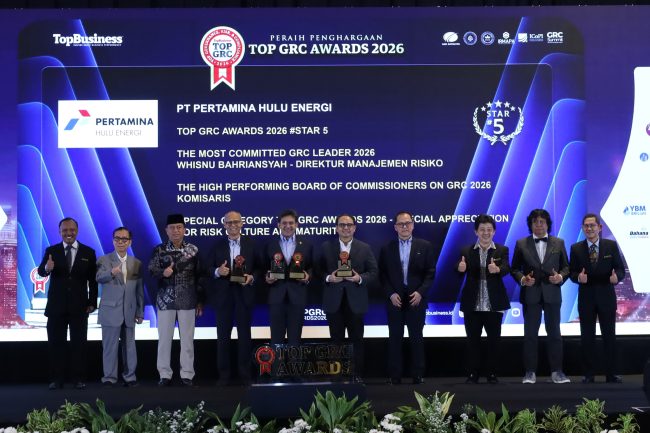
Jakarta, TopBusiness – A total of 108 top companies in Indonesia received awards at the TOP GRC Awards 2026, held at the Dian Ballroom, Hotel Raffles Jakarta, on Wednesday (9/9/2026).
Marking its eighth year since its inception in 2019, this assessment, award, and learning event for Governance, Risk, and Compliance (GRC) carried the theme “Sustainability by Design: A Journey Through Intelligent GRC”. The awards ceremony was attended by over 400 participants representing the winning companies.
The achievement of these 108 companies demonstrates the expanding corporate focus in Indonesia towards strengthening GRC. However, the challenges facing companies are no longer merely about possessing GRC policies, structures, and documentation.
Beyond that, GRC is required to be integrated with business strategies and processes, improving the quality of decision-making, anticipating risks, and creating sustainable value.
The theme “Sustainability by Disgn: A Journey Through Intelligent GRC” reinforces this direction. Sustainability is not enough to be placed as an end goal or an additional programme; it must be designed from the outset and embedded into strategy, governance, decision-making, risk management, compliance, control, business processes, organisational culture, and the utilisation of data and technology.
The TOP GRC Awards is organised by TopBusiness Magazine in collaboration with the Indonesian GRC Association, IRMAPA (Indonesia Risk Management Professional Association), ICoPI (Institute Compliance Professional Indonesia), the Indonesian Governance Professional Association (PaGI), and LKN Astacita, with support from GRC practitioners, consultants, and academics from the University of Indonesia and Padjadjaran University.
Awards are More Than Just Stars
The Chairperson of the TOP GRC Awards 2026 and Editor-in-Chief of TopBusiness Magazine, M. Lutfi Handayani, MM., MBA, emphasised that the core character of the TOP GRC Awards lies in the combination of assessment, awards, and learning.
Participants do not only receive recognition for their GRC implementation achievements but also gain a space to reflect on their practices, receive feedback from the Jury Board, conduct benchmarking, and identify areas that require further strengthening.
“The award is a form of appreciation for achievements. However, the assessment and judging process must provide added value in the form of insights and improvement agendas. We hope participants do not only ask ‘how many stars did we obtain’, but also ‘where is our GRC maturity position, what are the gaps, and what needs to be improved next’,” said Lutfi.
This message is highly relevant amidst an increasingly complex risk and business landscape. Companies cannot simply pursue compliance status. GRC must evolve into a capability that provides insights, becomes part of strategic decision-making, strengthens resilience, and creates sustainable value.
Towards Intelligent GRC
The Chairperson of the TOP GRC Awards 2026 Jury Board, Dr. Antonius Alijoyo, ERMCP., CERG., emphasised that Intelligent GRC is not merely the digitalisation of GRC documents or processes.
The use of data, technology, analytics, and Artificial Intelligence must be directed towards strengthening the quality of information, accelerating risk detection, increasing the effectiveness of controls, and assisting management in making decisions that are faster, more accurate, ethical, and responsible.
“The journey towards Intelligent GRC is a journey to make GRC increasingly integrated with business—moving from merely fulfilling obligations towards GRC that provides insights, supports strategic decisions, strengthens resilience, and creates sustainable value,” said Antonius.
The TOP GRC Awards 2026 series also presented perspectives from KNKG, the Indonesian Ministry of Finance, and BPI Danantara regarding the strengthening of governance, risk management, control, accountability, sustainability, and the use of technology.
The General Chair of KNKG, Prof. Dr. Mardiasmo, MBA., Ph.D., underscored the importance of strengthening governance, which should not stop at compliance and structural completeness, but should be reflected in ethical behaviour, decision quality, stakeholder protection, resilience, and long-term value creation.
In the context of Sustainability by Design, sustainability needs to be designed from purpose, strategy, and risk appetite to resource allocation. Meanwhile, Intelligent GRC must strengthen human accountability, not replace it.
“This transformation requires companies to break down the ‘silo’ barriers between departments by synergising three main global standards: ISO 37000 as the direction-setter for purpose-based governance, ISO 31000 as the strategic risk management radar, and ISO 37301 as the foundation for an organisational culture of compliance,” said Mardiasmo.
Meanwhile, Dr. Nur Rachmad, Secretary of the Inspectorate General of the Indonesian Ministry of Finance, in his remarks, brought the perspective of strengthening GRC in maintaining the credibility of financial management, accountability, internal control, and digital transformation. His message positioned GRC as part of strategic decisions: strategy, performance, risk, control, compliance, and assurance should be read as a single unity.
Risk dashboards need to evolve from mere reporting towards early warning and decision intelligence, while the use of data and Artificial Intelligence must be built upon digital trust, human oversight, auditability, security, and accountability.
Furthermore, the Managing Director of Risk & Sustainability at BPI Danantara, Effendi Hengki, assessed that GRC can no longer be viewed merely as a compliance function, but must become a strategic enabler and an instrument for value creation.
“Effective GRC helps leaders take risks more boldly yet in a measurable way according to risk appetite, protects investment value from unwanted risks, while simultaneously capturing strategic opportunities and improving quality”