
100 Years of Ali Sadikin: Fauzi Bowo Calls for Revival of Vision to Build Jakarta as a Cultural City
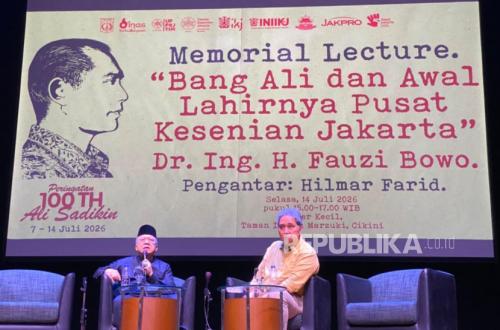
REPUBLIKA.CO.ID, JAKARTA – The commemoration of the 100th anniversary of the birth of Ali Sadikin, Governor of Jakarta from 1966 to 1977, has become a moment to remember his grand vision of building Jakarta as a city that is not only physically and economically advanced, but also rich in character through arts and culture.
Fauzi Bowo, a former Governor of Jakarta who also served on Ali Sadikin’s staff, said that from the start of his leadership in 1968, Ali Sadikin believed cultural development to be an inseparable part of urban development.
According to Fauzi, one of the first questions Ali Sadikin asked upon taking charge of Jakarta was why the artists who once gathered in the Senen area were no longer to be seen. The answer he received was simple, yet deeply meaningful: the artists no longer had a space in which to work.
“From that moment came Bang Ali’s conviction that the government has an obligation to provide spaces for artists to create, to innovate, and to convey their ideas to the public,” said Fauzi in a statement quoted on Friday (17/7/2026).
Ali Sadikin took the view that a city’s progress could not be measured solely by the construction of high-rise buildings or economic growth. A vibrant artistic and cultural life was a key indicator of a city’s quality.
For him, culture was the foundation of development because it shapes the character of society, strengthens a city’s identity, encourages creativity, and provides a space for healthy dialogue in democratic life.
Therefore, the government must act as a facilitator rather than a controller. Artists must be given freedom to create without interference, whilst remaining mindful of their responsibility to society.
This vision took shape in 1968 with the establishment of the Jakarta Arts Council (Dewan Kesenian Jakarta, DKJ) as a government partner in nurturing artistic and cultural life. In the same year, Ali Sadikin inaugurated the Jakarta Arts Centre, later named Taman Ismail Marzuki (TIM).
Fauzi stressed that TIM is the most tangible symbol of Ali Sadikin’s cultural vision. “TIM is not merely a collection of performance halls. TIM is a home for Indonesian artists to create, learn, discuss, experiment, and meet the public. It is where an arts ecosystem was built,” he said.
During Ali Sadikin’s tenure, around 250 arts and cultural activities were held at TIM every year. Ticket prices were kept affordable so that people from all walks of life could enjoy artistic works.
This commitment was reinforced by the founding of the Jakarta Arts Education Institute (LPKJ) in 1970, the forerunner of the Jakarta Institute of the Arts (IKJ), as well as the establishment of the Akademi Jakarta in 1973 as a body responsible for maintaining the quality of Jakarta’s cultural life.
Attention to preserving local culture was also realised through the formation of the Betawi Cultural Institute (LKB) in 1977, managed by the community with government support to nurture and develop Betawi arts and culture.
According to Fauzi, one of Ali Sadikin’s greatest legacies was his courage in making culture a long-term investment. Not every artistic activity generates economic profit, yet many carry vital social, educational, and civilisational value, making them worthy of government support.
Facing the challenges of the digital era, Fauzi believes the values Ali Sadikin passed down remain relevant as guiding principles.
He cited at least five principles that must continue to be upheld: artists’ creative freedom, the government’s support for arts and cultural practitioners, limited government intervention in the creative process, strengthening cultural spaces down to city, district, and neighbourhood levels, and collaboration between government, communities, universities, and the private sector in building a cultural ecosystem.
Looking ahead, TIM is expected to develop further as a platform integrating all arts and culture stakeholders in Jakarta, while serving as a national centre of learning on managing arts facilities, developing creative talent, staging performances, cultural subsidy systems, and public dialogue through artistic works.
“Ali Sadikin opened the way and laid the foundation of Jakarta as a city of arts and culture. Our responsibility today is to safeguard, nurture, and develop that legacy so that it remains alive and benefits future generations,” Fauzi concluded.
The centenary of Ali Sadikin’s birth is hoped to become a moment to strengthen the commitment of all stakeholders in building Jakarta as a global city firmly rooted in arts, culture, and freedom of expression.