
100 GWp Solar Power Programme Requires Rp1,140 Trillion: The Investment Challenges
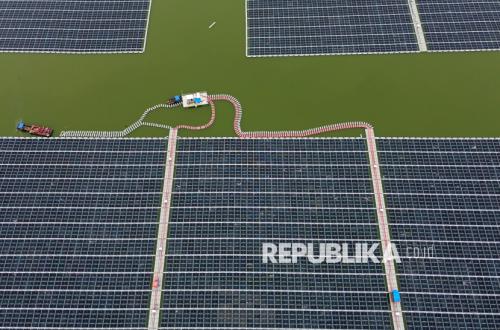
JAKARTA – Developing 100 gigawatt-peak (GWp) of solar power capacity over three years will require investment of around US$71.3 billion, equivalent to Rp1,140 trillion. Certainty over projects, power-purchase contracts and infrastructure readiness will be crucial to attracting investors and financial institutions to deliver the target.
Adhi Sulistyo Wibowo, a member of the Supervisory Board of Standard Chartered Indonesia, said investor interest in solar power development in Indonesia was substantial. However, investors and financial institutions need certainty over power-purchase contracts, tariffs, risk allocation, permits and land access before deciding to provide funding. “The longer the contract and the longer the financing period, the greater the level of certainty lenders expect,” Adhi said at the Katadata Policy Dialogue, entitled ‘Abundant Solar Energy: How Can Solar Power Development Be Accelerated?’, in Jakarta on Thursday (26 November 2026).
He said solar power projects had good financing prospects, including plants integrated with energy storage technology or batteries. Nevertheless, long-term investment in the energy sector requires certainty over contracts and policy so that financing risks can be managed.
According to Adhi, the government needs to strengthen cross-sector coordination to accelerate solar investment. This includes facilitating access to land, ensuring transmission network readiness, and coordinating among the government, PLN and relevant institutions. “PLN cannot do this alone. It is a shared responsibility,” Adhi said.
He also said solar power development needed to be accompanied by growth in electricity demand. The government should encourage industrial activity, downstream processing and electrification across various sectors of the economy so that new power plants have a clear market.
Energy and Mineral Resources Minister Bahlil Lahadalia previously said that developing 100 GWp of solar capacity would require US$71.3 billion in investment. He announced the figure at the launch and groundbreaking of the 100 GWp solar programme in Gilimanuk, Bali, on 25 August 2026.
The government has opened the door to private-sector participation through the Independent Power Producer (IPP) scheme. Danantara is also an option if competitive investment offers from private companies are not forthcoming.
Abraham Octama Halim, Manager of Energy Modelling and Power System Analysis at the Institute for Essential Services Reform (IESR), said the 100 GWp solar development target was technically achievable. Indonesia’s solar energy potential is estimated at between 3,000 and 7,000 GWp. “The root issue is that we need to build the ecosystem,” Abraham said.
He explained that the challenges did not lie in the availability of energy resources or technology, but in the readiness of regulations, infrastructure and financing arrangements that would enable projects to operate sustainably.
In his view, the government should pursue solar development through several channels, including large-scale plants connected to the electricity grid, solar installations in remote areas and rooftop solar. Each requires appropriate policies and infrastructure support. “The regulatory framework needs to be clear. Perhaps we do not need to keep tinkering with one regulation after another,” Abraham said.
He also highlighted the importance of strengthening the electricity grid and developing batteries. Increasing solar capacity without improving the flexibility of the electricity system could create imbalances between supply and demand.
From the market perspective, Abindra Soemali, Manager for Low Carbon Energy and Industry at Systemiq, said certainty over electricity demand was essential to attracting investment in solar power. Investors need a clear picture of the market and cash flow before deciding to finance power plant construction. “Building a market or generating demand is very important,” Abindra said.
Abindra said industrial estates and rural economies had the potential to generate demand for solar electricity. Industrial estates have relatively clear energy needs, while rural areas can use solar power to support productive economic activities.
These uses include powering agricultural irrigation, cold storage for fishery products and processing fishermen’s catches. “Supply and demand need to be planned together,” Abindra said.
He stressed that solar power development should be aligned with growing electricity needs across different sectors of the economy. Such planning is necessary to ensure that investment in power plants not only increases national electricity capacity but also supports productive economic activity.
Source: jawawa.id (https://jawawa.id/newsitem/100-gwp-solar-power-programme-requires-rp1-140-trillion-the-investment-challenges-1795701077)
Originally published by Republika (https://ekonomi.republika.co.id/berita/tp41bh416/program-plts-100-gwp-butuh-rp1140-triliun-ini-tantangan-investasinya), translated from Indonesian