
100 GWp Solar Power Programme Launched, PLN Ready to Support Acceleration of Renewable Energy Development
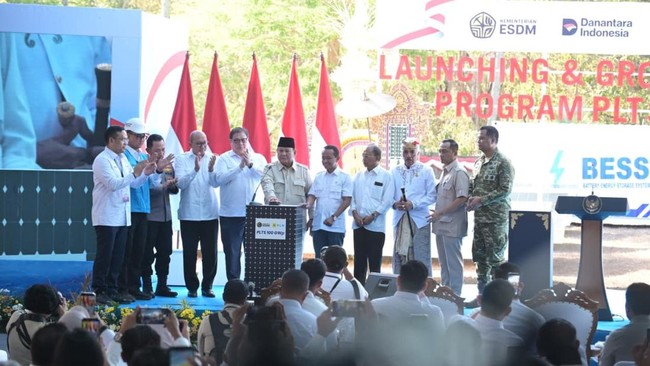
President Prabowo Subianto has launched the 100 gigawatt peak (GWp) Solar Power Plant Programme, while also breaking ground on projects set to accelerate national renewable energy development in Gilimanuk, Bali. In its initial phase, the programme encompasses 14 solar power projects with a total capacity of 5,300 megawatt peak (MWp) spread across various regions of Indonesia. The move implements the government’s asta cita goals of energy self-sufficiency and downstreaming through the utilisation of renewable energy.
Prabowo said solar energy development is one of the strategic steps to accelerate the realisation of Indonesia’s energy independence and self-sufficiency. According to him, the utilisation of renewable energy potential must be carried out massively so that national energy needs can be met from domestic energy sources while providing broad economic impact for the community.
“Today is an important day, we are launching electricity from solar power of 100 GW for the Indonesian nation. With the 100 GWp Solar Power Programme, we will truly become a nation standing on our own feet,” Prabowo asserted.
On the same occasion, Minister of Energy and Mineral Resources Bahlil Lahadalia said the development of the 100 GWp solar power programme is a follow-up to President Prabowo’s directive to seek breakthroughs in accelerating national energy sovereignty. Therefore, solar energy development is being carried out by utilising the potential of available resources in various regions of Indonesia through various scenarios, ranging from large-scale solar power plants, floating solar, rooftop solar, to solar development for industrial estates and productive activities.
“Today we are taking a big step to realise what the President has always directed us to do, namely national energy self-sufficiency and sovereignty. Indonesia is a country that God has given extraordinary resources. Resources that are not only beneath our feet, but also above our heads,” Bahlil said.
He added that the 100 GWp Solar Power Programme will be developed through eight main scenarios, including the elimination of coal-fired power plants amounting to 12.48 GWp, large-scale solar development through the Electricity Supply Business Plan reaching 30.97 GWp, floating solar of 10.72 GWp, rooftop solar of 9.35 GWp, solar for underdeveloped, frontier and outermost regions of 0.50 GWp, off-grid solar for productive activities of 4.36 GWp, non-rooftop solar for industrial estates of 7.49 GWp, as well as demand creation through downstreaming, electric vehicles, induction cookers and other needs of 24.13 GWp.
“If we are able to implement all of this, we can reduce emissions by 140 million tonnes of CO2 per year with a carbon economic value of 6.31 trillion rupiah,” Bahlil said.
According to him, large-scale solar development also has significant economic impact. In terms of employment, the programme has the potential to create around 5.5 million jobs, consisting of approximately 3.465 million construction workers and 2.053 million manufacturing workers.
In the initial phase, the programme will provide positive economic impact through potential savings in fuel oil usage. The development of these projects will also serve as an economic catalyst in the regions through increased construction activity, manufacturing and community economic activity around project sites.
“The total investment for this project is approximately US$71.3 billion, equivalent to Rp1,140 trillion. From this total work, we can achieve annual subsidy efficiency of up to Rp73.9 trillion,” Bahlil explained.
PLN President Director Darmawan Prasodjo said PLN is ready to fully support the government’s vision in realising the asta cita goals of energy self-sufficiency and national downstreaming. The company is committed to accelerating the 100 GWp Solar Power Programme through collaboration with all stakeholders, as well as ensuring the readiness of the electricity system, supporting infrastructure and solar project development can run optimally.
“PLN is ready to carry out the President’s assignment to accelerate the development of 100 GWp solar power. As part of the national electricity ecosystem, PLN will go all out so that solar energy development can be integrated with the electricity system reliably, safely and sustainably. This is part of PLN’s commitment to support the realisation of energy self-sufficiency through the utilisation of domestic, environmentally friendly green energy,” Darmawan said.
He also expressed appreciation to the government for its support and direction in accelerating renewable energy development. According to him, the success of the 100 GWp Solar Power Programme requires cross-sector collaboration, between the government, PLN, business actors, industry and the community.
“We express our gratitude for the trust and support the government has placed in PLN. PLN is ready to collaborate with all stakeholders to ensure this programme can be implemented optimally. With strong collaboration, we can build a solar energy ecosystem that not only produces clean electricity, but also strengthens national industry and provides broad economic benefits,” Darmawan said.
He added that specifically in the Bali region, as the launch site of the national programme, PLN together with the Bali Provincial Government will develop five solar power clusters with a total capacity reaching 1,000 MWp supported by a 3,300 MWh Battery Energy Storage System. This major step is an important foundation in building a clean energy ecosystem in Bali, as a premier tourism destination and Indonesia’s face to the world.
“In this collaboration, the solar capacity to be developed in the Bali region reaches 1,000 MWp, of which solar plants with a total capacity of 300 MWp will be developed in the Gilimanuk Cluster,” Darmawan said.