
100 GWp Solar Power Plant Programme Could Save State Budget Rp 73 Trillion
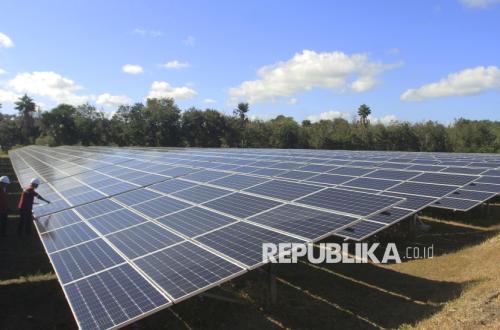
Minister of Energy and Mineral Resources (ESDM) Bahlil Lahadalia has said the 100 gigawatt peak (GWp) Solar Power Plant (PLTS) Programme could save the state budget (APBN) by more than Rp 73 trillion each year. The savings stem from the lower cost of solar power generation compared with diesel- and gas-fired power plants.
The government officially launched the 100 GWp PLTS Programme with a groundbreaking ceremony in Gilimanuk, Bali, on Tuesday (25/8/2026). The programme is part of the government’s efforts to strengthen national energy independence and security by harnessing Indonesia’s abundant solar energy potential.
“Through the 100 GWp PLTS, we will truly stand on our own feet,” Bahlil said, as quoted on Wednesday (26/8/2026).
In addition to budget savings, the programme is projected to reduce national diesel consumption by up to 6 million kilolitres per year. In Bali alone, solar energy development is estimated to save around 500,000 kilolitres of diesel consumption annually.
Bahlil said Indonesia has significant capital to develop solar energy. As a tropical country that receives sunlight throughout the year, Indonesia also already has a domestic solar panel industry and a battery energy storage system (BESS) industry.
The development of the 100 GWp PLTS is also projected to generate broad economic benefits. The programme could cumulatively create 5.52 million jobs, comprising around 3.5 million jobs in the solar panel and BESS industries and 2 million jobs in the construction sector.
From an environmental perspective, large-scale solar power development is projected to reduce carbon emissions by up to 140.16 million tonnes of CO2 per year. This emissions reduction also has a potential carbon economic value of Rp 6.31 trillion.
As an initial phase, the government has launched 14 PLTS projects across six provinces with a total capacity of around 5.3 GWp. Projects in this initial phase include the 300 MWp Gilimanuk PLTS, the 134 MWp Gajah Mungkur Floating PLTS, the 0.92 MWp Sembur Village PLTS, and the 0.078 MWp Rengit Island PLTS.
President Prabowo Subianto has stressed that the government is serious about pursuing large-scale solar energy development. The government is targeting the construction of 100 GWp of solar capacity within three years through collaboration between ministries, state-owned enterprises, and other relevant parties.
The programme is directed not only at increasing power generation capacity but also at reducing dependence on fossil fuels and strengthening the domestic clean energy industry. Expanding PLTS development to island regions is also expected to widen electricity access while creating energy cost efficiencies for the public.