
1,360 Students Begin Studies at 17 Integrated National Schools
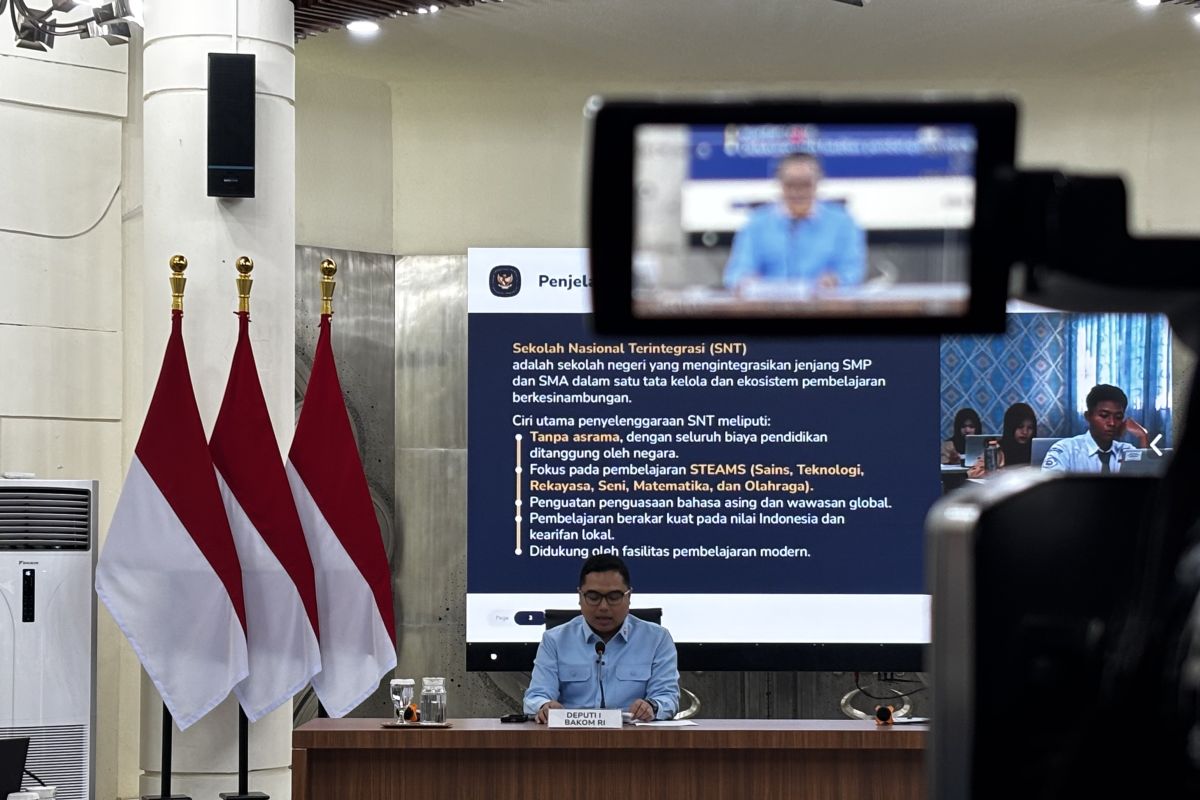
Approximately 1,360 high-achieving students are currently beginning their new academic year at 17 Integrated National Schools (SNT), as part of the government’s efforts to ensure educational equity.
Deputy I for Strategy and Communication Systems at the Government Communication Agency (Bakom) RI, Fahd Pahdepie, explained during a press conference in Jakarta on Wednesday that this marks the first cohort for the SNT programme. “Currently, because it has just opened and is still in the school orientation period, this is the first batch for this SNT. As mentioned, for the junior high school level there are 20 students in 2 classes, and likewise for the senior high school level, 20 students,” he stated.
He noted that the development of SNT was prompted by the government’s observation of persistent disparities in national education quality. Data from the Ministry of Primary and Secondary Education (Kemendikdasmen) as of 30 June 2025 indicates that only 4 per cent, or 263 out of 7,288 sub-districts in Indonesia, have junior and senior high schools with good performance, specifically those with ‘A’ accreditation. The distribution of these quality schools remains concentrated on the island of Java, with only four such schools spread across three sub-districts in Papua.
The government plans to expand the SNT programme to 500 educational units across Indonesia, equipped with adequate facilities including libraries with access to global e-journals, discussion rooms, sports centres, and student shuttle services. Currently, the 17 operational SNT units are staffed with competent teachers, comprising 17 head teachers and 204 educators.
Fahd Pahdepie emphasised that the SNT programme has a distinct focus compared to the Sekolah Rakyat (People’s Schools) and Sekolah Unggul Garuda (Garuda Excellent Schools) programmes, despite sharing the common goal of ensuring the best education for every Indonesian child. The SNT is specifically designed to become a centre for educational development in the regions through teacher competency improvement, sharing of best practices, utilisation of learning resources, and partnerships with surrounding schools. The programme integrates junior and senior high school levels into a single learning ecosystem, where students follow the national curriculum through an in-depth learning approach based on STEM (science, technology, engineering, arts, and mathematics) and sports, while also being given broader space to develop their character, interests, and talents.