
1,190 infertile turtle eggs found in Sambas destroyed
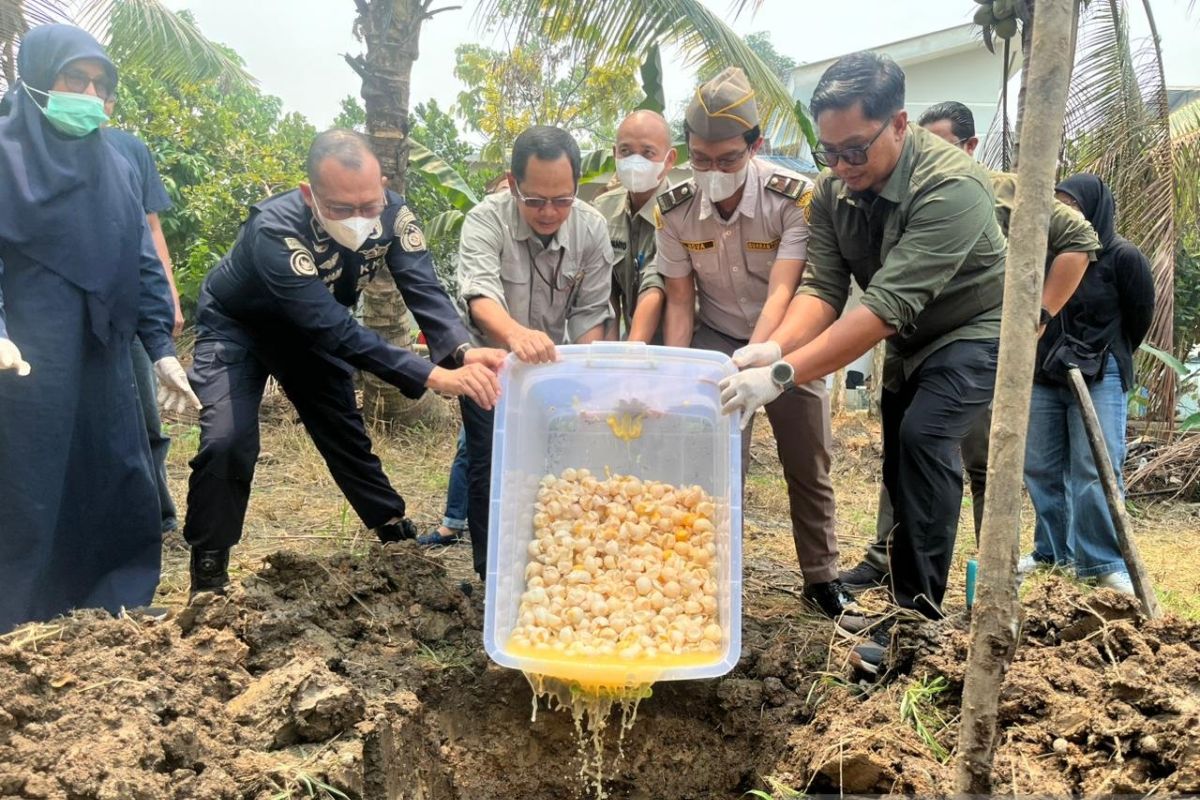
The Pontianak Marine and Fisheries Management Office (Balai PK) has destroyed 1,190 turtle eggs found in Sambas that were declared infertile or unable to be fertilised and hatched, as part of efforts to protect the fully protected species.
“We at Balai PK Pontianak carried out the destruction of 1,190 infertile turtle eggs. This means the turtle eggs cannot be hatched and cannot be fertilised,” said Deden Solihin, Head of the Species and Genetic Conservation Management Working Team at Balai PK Pontianak, in Pontianak on Saturday.
Meanwhile, 96 other turtle eggs are still placed at an incubation site to receive handling until the hatching process.
He said the destruction is a follow-up to the transfer of conservation management authority under Law Number 32 of 2024, with authority now vested in the Ministry of Marine Affairs and Fisheries (KKP).
Deden urged the public to help maintain the turtle population by not taking, trading, or utilising any parts of the animals or their eggs.
At the same location, Marine Megafauna Specialist at Sealife Indonesia, veterinarian Dwi Suprapti, emphasised that the public belief that turtle eggs have many benefits and properties for human stamina is a myth.
She said scientific studies have shown that the content of turtle eggs is actually almost the same as chicken eggs.
According to her, turtles are animals that migrate quite far and have long lifespans. As a result, turtle bodies automatically carry pollution that has the potential to cause disease, such as heavy metals carried in their bodies.
“If it has accumulated in sufficient quantities, it can pass down to the eggs in the form of mercury, cadmium, lead or black tin. It can transfer from the mother to the eggs, and then to humans, which automatically poses a risk of kidney and liver disease in humans,” she said.
Dwi reminded the public that it is better not to consume turtle eggs, and that chicken eggs are actually healthier because chickens can have their living areas controlled and their lifespans are short, so the potential for pollution in their bodies is small.