
Indonesia's Economy Grows 5.61%, BPS Attributes Role to MBG Programme
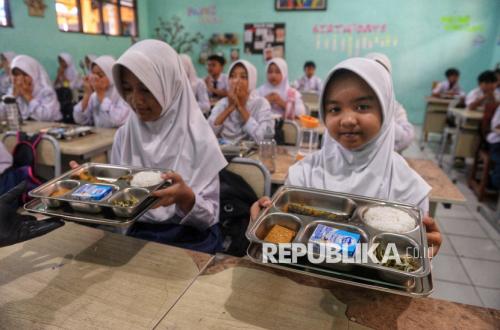
The Head of the Central Statistics Agency (BPS), Amalia Adininggar Widyasanti, stated that the Free Nutritious Meals (MBG) programme and the Red and White Village/Urban Ward Cooperatives (KDKMP) have contributed to boosting Indonesia’s economic growth. Amalia noted that Indonesia’s economy grew by 5.61% year-on-year in the first quarter of 2026 compared to the same period in 2025.
“We observe that there are indeed many national strategic projects contributing to gross fixed capital formation (PMTB) in the first quarter of 2026,” Amalia said during a press conference on economic growth at the BPS office in Jakarta on Tuesday (5 May 2026).
Amalia explained that several government strategic programmes include physical construction, purchases of machinery, equipment, vehicles, Red and White Village Outlets, MRT development with physical investments exceeding Rp 25 trillion, as well as infrastructure, connectivity, and food self-sufficiency programmes. She also highlighted the massive physical construction of Service Units for Nutritional Fulfilment (SPPG) or MBG Kitchens.
“The growth in the number of SPPGs has a positive impact on PMTB due to the physical construction involved. In the first quarter of 2026, up to March 2026 compared to December 2025, there was an addition of 6,737 new SPPG units,” Amalia added.
In addition to national strategic programmes, BPS recorded a significant contribution to economic growth in the first quarter of 2026 from the accommodation and food and beverage services sector, which experienced the highest growth of 13.14%. From the expenditure side, the government consumption expenditure (PK-P) component saw the highest growth of 21.81%.
Amalia mentioned several factors contributing to the growth of the PK-P component, including the realisation of 14th-month salary payments or THR, salaries from new civil servant additions, accelerated payments of allowances for non-civil servant educators, and increased government spending on goods and services in the first quarter of 2026.
“The question is, government consumption has the highest growth at 21.81%, but its contribution is only 6.72%. Why is that? If we look at Indonesia’s GDP, it is primarily supported by household consumption and PMTB, as they have the largest share in terms of GDP value,” Amalia explained.