
Countries with the Strictest Halal Certification Systems: Is Indonesia Among Them?
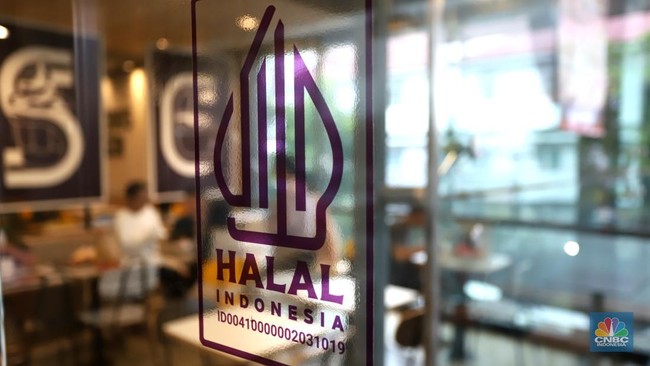
Jakarta, CNBC Indonesia — The government will begin enforcing mandatory halal product assurance on Sunday (18 October 2026), in accordance with Law No. 33/2014.
Ahead of the deadline for mandatory halal certification of products, including food and drink, the government is providing free halal certificates for 1.35 million micro, small and medium-sized enterprises (MSMEs).
Co-ordinating Deputy Minister for Economic Affairs Dradjad H. Wibowo announced this at the Indonesia Sharia Economic Festival (ISEF) 2026 in Jakarta on Wednesday (14 October 2026).
“Of course, in implementing this free halal certification programme, we are taking the readiness of business operators into account,” Dradjad said.
The government says the halal product assurance policy, which comes into force tomorrow, is intended to guarantee product quality and strengthen the competitiveness of national industry.
“God willing, in three days we will begin implementing halal product assurance. This policy protects consumers, guarantees product quality and strengthens the competitiveness of national industry,” Dradjad said.
The Halal Product Assurance Organising Agency (BPJPH) previously confirmed that, from 18 October 2026, all food and drink products made by micro and small enterprises (MSEs) must be halal-certified.
The requirement is mandated by Law No. 33/2014 on Halal Product Assurance and Government Regulation No. 42/2024 on the Implementation of Halal Product Assurance.
“Putting halal procedures in order now is very important. In addition to meeting regulations, it is also a strategy for strengthening Indonesia’s business ecosystem,” Babe Haikal, as he is commonly known, said last year.
He added that mandatory halal certification is intended to protect the public while providing measurable, data-based certainty for businesses.
At the same time, he said, the policy would allow flexibility and tolerance for businesses that were not yet ready.
“Concerns about readiness to implement mandatory halal certification should be assessed using official data and information. Some requests to postpone implementation have arisen from the use of inaccurate data or an incomplete understanding of how the requirement works,” he said, according to a statement on the BPJPH website on Tuesday (6 October 2026).
“If the data is correct and we fully understand the requirements, there is actually no reason to say Indonesia is not ready. So, if anyone is asking for a delay, let us look at the data. Decisions should not be made on the basis of incorrect data or a misunderstanding of mandatory halal certification,” Haikal said.
Haikal said implementation would not be coercive. Businesses that were not ready need not worry, as the government would provide time and guidance to help them meet their obligations under the rules.
“If anyone is not ready, tell us. We will of course give you time — another year, two years, if necessary. The important thing is that we help you until you are ready,” he said.
Haikal added that businesses that did not wish to display a halal label need not be concerned, as halal assurance is intended for those seeking certainty and guarantees about a product’s halal status.
“If you do not want a halal label, that is fine. Halal assurance is intended for those who want it. What matters is that no one claims a product is halal without meeting the requirements,” he said.
He also assured businesses there would be no compulsion or raids as part of the implementation of mandatory halal certification.
“There will be no coercion and no raids. The principle is simple: those who are ready can meet their obligations; those who are not ready will be helped until they are. The government will ensure that everything is carried out in accordance with the rules,” Haikal said.
Countries with the strictest halal certification systems
As public awareness of halal lifestyles grows, halal certification is no longer merely a local requirement but has become a global standard.
Some countries have highly stringent and structured certification systems covering the entire supply chain, from raw materials to distribution. The following five countries are recognised for having some of the strictest and most trusted halal certification standards.
1. Malaysia
Malaysia is often described as a pioneer in halal assurance. Through JAKIM, Malaysia sets detailed and comprehensive halal standards.
These standards cover the selection of halal raw materials, production processes free from contamination, packaging and distribution systems, and regular audits of manufacturing facilities.
JAKIM certification is now recognised globally and serves as a benchmark for many other countries. Malaysian halal products can readily enter international markets.
2. United Arab Emirates
As a major trading hub in the Middle East, the United Arab Emirates (UAE) has developed a modern and transparent halal certification system under the Ministry of Industry and Advanced Technology (MoIAT).
The UAE’s halal standards cover not only food but also cosmetics and pharmaceuticals, logistics and supply chains, and other consumer products.
The UAE also uses blockchain technology to ensure data transparency and traceability of halal products throughout the supply chain.
3. Saudi Arabia
Saudi Arabia has established a highly conservative and stringent halal certification system. The Saudi Food and Drug Authority (SFDA) is responsible for closely monitoring food, pharmaceutical and cosmetic products entering the country.
Products intended for distribution must undergo inspection and laboratory testing, be accompanied by a halal certificate from a recognised Saudi body, and be produced at audited facilities.
These standards are intended to protect the religious integrity of consumption in the Muslim holy land.
4. Australia
Australia has shown that countries where Muslims are not the majority can also have strong halal systems. Organisations such as Australian Halal Food Services (AHFS) have worked with Muslim-majority countries, including Indonesia and Malaysia, to align their standards with international ones.
Australia’s main focus is on the halal status of meat exports and processed products, slaughtering in accordance with Islamic law, and food safety and traceability systems.
The rigour of these systems has helped make Australian meat products popular in many Muslim countries, including those in the Middle East and South-East Asia.
Strict halal standards matter not only to Muslim consumers but can also improve overall product quality.
5. Indonesia
As the country with the world’s largest Muslim population, Indonesia has made halal certification a legal requirement under Law No. 33/2014 on Halal Product Assurance.
The process is overseen by BPJPH, working with Halal Inspection Bodies (LPH) and the Indonesian Ulema Council (MUI). The standards cover audits of raw materials and additives, inspections of production facilities, certification of halal supervisors, and periodic monitoring and evaluation.
The system is designed to ensure that products circulating in Indonesia comply with Islamic law.